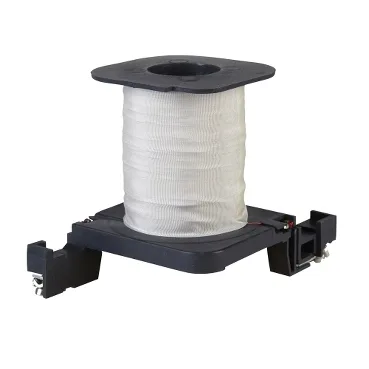
The LX4D7KD is a DC-operated contactor coil from the TeSys Deca range, specified for 100 V DC control circuits and designed to drive an 80 A rated contactor. It's a replacement or service-part coil — the kind you order when the original coil in an existing TeSys Deca assembly fails or needs a voltage change. The coil draws 22 W inrush and hold-in at 68 °F (20 °C), with an average resistance of 458.6 Ohm. No built-in suppressor module is included, so you'll need to add external flyback suppression (a diode or RC snubber) across the coil terminals if the driving PLC output or relay doesn't already provide it.
The 100 V DC control voltage is the headline spec — this coil is built for DC control circuits, not AC. The drop-out threshold sits at 0.1 to 0.3 Uc (10 to 30 V DC), and the operational pickup range is 0.85 to 1.1 Uc (85 to 110 V DC) at temperatures below 131 °F (55 °C). If your control voltage sags below 85 V DC during a brownout, the contactor may drop out unexpectedly; that's the engineering trade-off for a standard DC coil without a wide-range or electronic coil. The time constant of 75 ms governs how quickly the magnetic field builds and collapses — it's the time to reach 63% of steady-state current. That matters for coordination with the contactor's main poles: too slow a coil response can cause arcing on make or break, especially under motor load. For a 100 V DC coil driving an 80 A contactor, 75 ms is within the expected range for a standard DC solenoid.