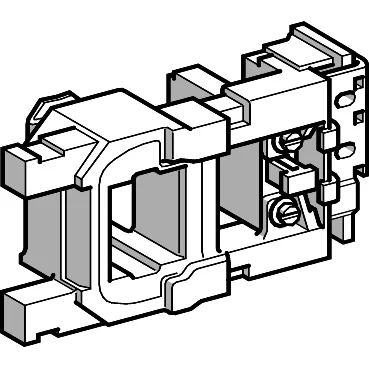
The LX4FF170 is a replacement contactor coil from the Schneider TeSys F range, designed for 170 V DC control circuits. It's the service part you order when the original coil on an LX4FF-series contactor fails or needs a voltage change. Rated for 170 V DC control voltage with an operational range of 0.85 to 1.1 Uc at 131 °F (55 °C) — meaning it holds in from about 144.5 V to 187 V DC. Dropout occurs between 0.15 and 0.2 Uc (roughly 25.5 to 34 V DC), so it releases cleanly on a sagging bus without chattering.
Switching performance and durability
Closing time runs 30 to 40 ms, opening 30 to 50 ms — consistent with a DC-operated contactor coil of this frame size. Maximum operating rate is 2400 cycles per hour at 131 °F (55 °C), which suits moderate-speed conveyor or pump cycling but not high-speed jogging. The inrush power draw is 560 W at 68 °F (20 °C), dropping to 4.5 W hold-in power — typical for a DC low-consumption coil design that keeps the solenoid pulled in with minimal heat.
Installation note — suppressor module required
This coil ships without a built-in suppressor module. On a DC coil that means you must add an external flyback diode or RC snubber across the terminals — otherwise the inductive kick when de-energizing can weld auxiliary contacts or damage the PLC output driving it. Standard practice: a 1N4007 diode (or equivalent) cathode to positive, anode to negative, placed as close to the coil terminals as panel wiring allows.