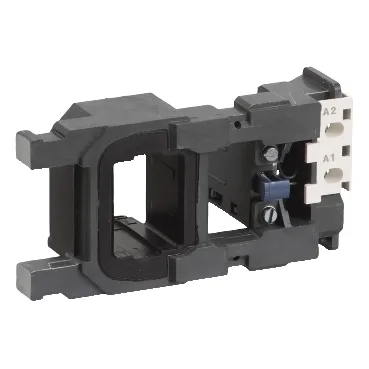
The LX4FG040 is a replacement contactor coil from the Schneider Electric TeSys F range, designed for 48 V DC wide-range control circuits. It is the coil that drives the main contactor in a TeSys F motor starter or contactor assembly — when the coil pulls in, the power contacts close; when it drops out, they open. The coil draws 800 W inrush at 20 °C and settles to 5 W holding power. The average resistance is 2 Ω inrush and 359 Ω holding at 20 °C, with a closed-circuit inductance of 34.4 H. The control circuit is DC wide range, meaning it accepts a broader voltage band than a standard DC coil — the operational limits are 0.7 to 1.25 Uc at 70 °C, and drop-out occurs between 0.2 and 0.45 Uc at 70 °C. This gives the coil some tolerance for voltage sag in the control circuit. There is no built-in suppressor module on this coil. That means the installer must add an external flyback diode or RC snubber across the coil terminals to protect the control circuit from the inductive kick when the coil de-energizes. The ambient temperature range for operation is -55 to 70 °C.
The 48 V DC control voltage is the nominal rating — the coil is designed to operate reliably at 48 V DC, but the wide-range design means it will pull in at voltages as low as 33.6 V DC (0.7 × 48 V) and hold in up to 60 V DC (1.25 × 48 V) at 70 °C. The drop-out range of 0.2 to 0.45 Uc (9.6 to 21.6 V DC) means the coil will release the contactor when the control voltage falls below that band, which is a safety feature for undervoltage protection. The 800 W inrush figure tells you the coil draws a heavy surge on energization — the control transformer or DC power supply must be sized to handle that transient without drooping below the pick-up threshold. The 1 Mcycles mechanical durability is the expected life of the coil mechanism under no-load switching. In a real application with a contactor switching motor loads, the electrical life of the main contacts will typically be shorter than the coil's mechanical life. The 60 cycles per hour maximum rate at 70 °C is a thermal limit — exceeding that rate can overheat the coil and reduce its service life.