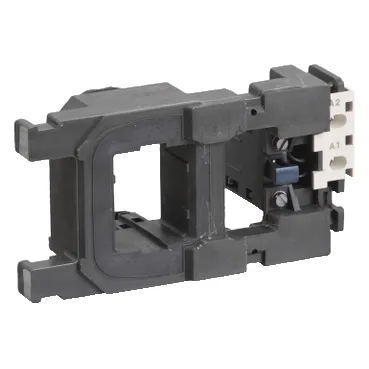
The LX4FH040: Coil technology is without built-in suppressor module. An external flyback diode or RC snubber must be added across the coil terminals when driving from a PLC or solid-state output — the coil's inductance of 59.5 H closed circuit will generate a significant inductive kick without one. Operating time runs 40 to 50 ms closing, 40 to 65 ms opening — consistent with the TeSys F family's standard response for a DC coil. Ambient temperature range spans -55 to 70 °C, so it works in outdoor cabinets or near ovens as long as the contactor's own rating is respected.
Sourcing reality — obsolete part
If you need a drop-in replacement, the closest functional match would be another TeSys F coil at the same 48 V DC control voltage — but pinout and mounting dimensions must be cross-checked against the specific contactor frame (LX4F... base).
Electrical characteristics at a glance
Inrush power hits 750 W at 20 °C, dropping to 5 W holding — typical for a DC-operated contactor coil that must pull in the armature against spring force then hold with much less energy. Average resistance is 2.19 Ω inrush, 400 Ω holding at 20 °C. Control voltage limits: operational range is 0.7 to 1.25 times Uc at 70 °C, drop-out occurs between 0.2 and 0.45 times Uc. This wide-range design tolerates voltage sag on long cable runs better than a standard 48 V coil. Maximum operating rate is 60 cycles per hour at 70 °C, with mechanical durability rated at 1 million cycles — sufficient for most process control applications but not for high-speed cycling like a pick-and-place machine.