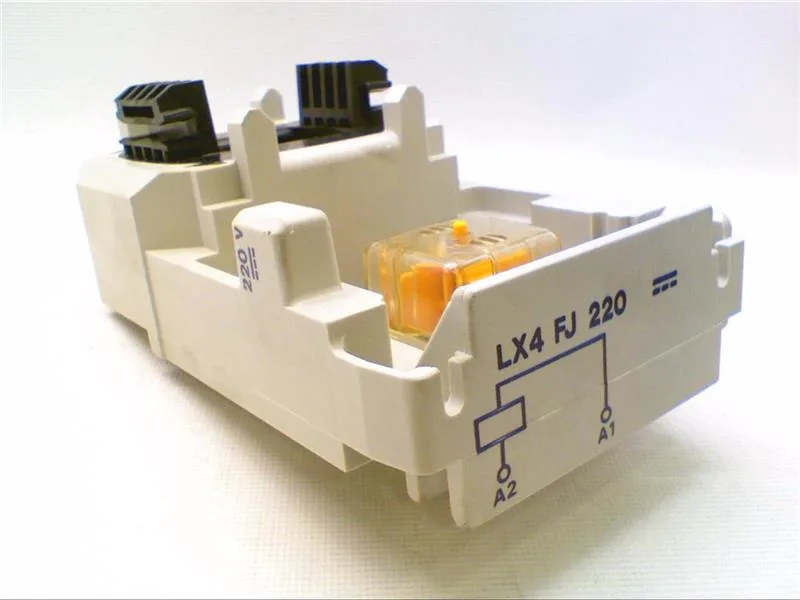
The Schneider LX4FJ048 is a replacement contactor coil from the TeSys range, designed for 48 V DC control circuits. It's a DC low-consumption type — meaning the inrush surge is short and the hold-in power stays low, which matters when the control transformer or DC supply is already loaded with other coils. Coil draw: 1000 W inrush at 20 °C, settling to 6 W holding at the same temperature. The inrush resistance is 2.5 Ohm; the holding resistance jumps to 558 Ohm as the armature seals. That's a 220× ratio — typical for a DC economizer design, not a simple resistor-limited coil. Operating time is 45 to 60 ms opening, 50 to 60 ms closing.
Control voltage limits and coil behaviour
The 48 V DC coil has defined pick-up and drop-out thresholds. It operates reliably between 0.85 and 1.1 Uc at 55 °C — so 40.8 to 52.8 V DC. Drop-out occurs between 0.2 and 0.35 Uc (9.6 to 16.8 V DC) at the same temperature. This wide drop-out band means the coil will release cleanly on a sagging DC bus without chattering. The closed-circuit inductance is 56 H, which combined with the 558 Ohm holding resistance gives a time constant of about 100 ms. That's relevant if you're sequencing multiple contactors off the same DC supply — the inductive kick from one coil can affect the pick-up timing of another if the supply isn't stiff enough. No built-in suppressor module on this coil. If your circuit needs flyback suppression (and it usually does with a DC coil driven by a PLC output or relay), you'll add a free-wheeling diode or a varistor externally. The coil itself is just the winding.
Where this coil fits
This coil is intended for TeSys D and TeSys F contactor frames — the ones that accept a separate coil as a field-replaceable part. It's not a complete contactor; it's the magnetic actuator that pulls the main poles in. If you're rebuilding a panel and the contactor body is sound but the coil is open or shorted, this is the swap part.