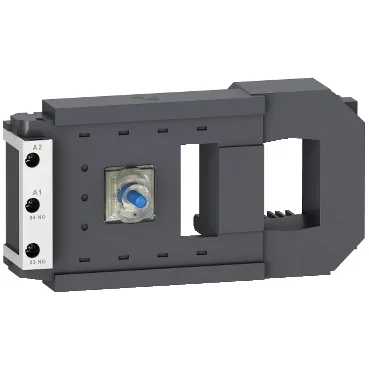
The LX9FF070 is a specific replacement coil for Schneider Electric TeSys F contactors, wound for 70 V AC control at 40 to 400 Hz. It is a low-consumption design — meaning the inrush and hold-in power are deliberately kept down to reduce thermal stress on the panel wiring and the contactor itself. The coil draws 690 to 855 VA inrush at 68 °F (20 °C), then settles to 6.6 to 8.1 VA holding. That inrush-to-hold ratio is typical of AC-operated contactor coils; the holding VA is low enough that a standard 70 V control transformer can supply multiple coils without excessive sag. Coil resistance measures 6.18 Ω inrush and 190.8 Ω holding at 68 °F (20 °C). The opening time is 130 ms, closing 35 ms — the asymmetry is normal for AC coils; the slower opening is inherent to the magnetic circuit decay.
Control voltage limits and operating window
The coil holds its armature across 0.85 to 1.1 Uc at 131 °F (55 °C), so it stays pulled in from about 59.5 V to 77 V AC. Drop-out occurs between 0.35 and 0.55 Uc — roughly 24.5 to 38.5 V AC — which is a standard margin for AC contactor coils and ensures positive release when the control signal is removed. Rated operating temperature is -5 to 55 °C (23 to 131 °F). The maximum operating rate at 55 °C is 2400 cycles per hour — enough for most motor starting and resistive load switching cycles, but not for high-speed jogging or repetitive inrush applications.
Schneider Electric lists the LX9FF070 as obsolete. Because this is a specific contactor coil — not a universal replacement — verify that the contactor frame and armature match the TeSys F series before committing the order. The coil has no built-in suppressor module, so an external RC snubber or varistor must be added across the coil if the control circuit requires one for EMI compliance or contact protection.
The 70 V AC control voltage is uncommon in North American panels (typically 120 V or 24 V) but standard in many European and Asian installations where 70 V control transformers are used. Heat dissipation of 5.9 to 7.2 W means the coil contributes measurable heat inside the enclosure. In a densely packed panel with multiple TeSys F contactors, the cumulative coil dissipation must be factored into the thermal budget — especially if the enclosure is sealed or has limited ventilation. The coil itself is rarely the life-limiting component in the contactor assembly; the main contacts wear out first under load switching.