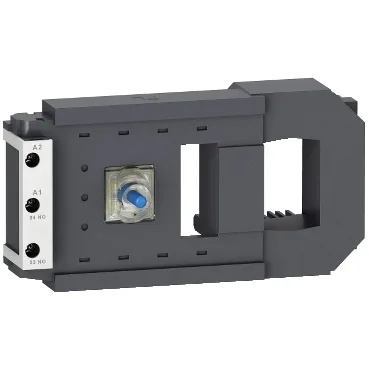
The LX9FF140 is a specific contactor coil from the Schneider Electric TeSys F range, designed to operate a TeSys F contactor. It is a low-consumption AC coil rated for 140 V AC at 40-400 Hz, drawing 690-855 VA inrush and 6.6-8.1 VA holding at 20 °C. The coil resistance measures 23.46 Ω inrush and 937.5 Ω holding at the same temperature. This coil is built without a built-in suppressor module, so if your application requires surge suppression, you will need to add an external RC snubber or varistor across the coil terminals.
Because this is a specific coil for the TeSys F contactor family, there is no direct pin-for-pin replacement from Schneider Electric that carries the same order code. If you are maintaining an existing panel, the best path is to source the LX9FF140 as a service part. For new designs, consider the current TeSys F coil offering — check the control voltage and mounting interface against your contactor frame.
The 140 V AC control voltage at 40-400 Hz means this coil is intended for AC control circuits, not DC. The operational voltage limits are 0.85-1.1 Uc at 55 °C, so the coil will pick up reliably at 119 V AC and must not see more than 154 V AC. Drop-out occurs between 0.35-0.55 Uc (49-77 V AC), which gives a reasonable hold-in margin against voltage sags. Heat dissipation runs 5.9-7.2 W, which is modest but should be considered when grouping multiple coils in a confined enclosure — derating may apply above 40 °C.