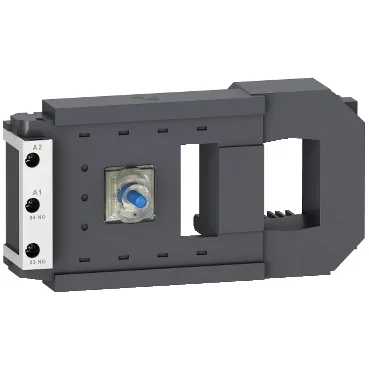
The LX9FF150 is a specific contactor coil from the Schneider Electric TeSys F range, designed as a replacement coil for TeSys F contactors. It is a 150 V AC coil rated for 40 to 400 Hz supply, in the low-consumption variant. This is not a complete contactor — it is the coil assembly only, intended to swap onto an existing TeSys F contactor frame. The coil draws 690 to 855 VA inrush at 20 °C, then holds in at 6.6 to 8.1 VA. That inrush figure matters for sizing the control transformer — a 150 VA transformer will handle the peak, but a 50 VA control transformer will drop out under load. The holding consumption of 6.6 to 8.1 VA is modest, dissipating 5.9 to 7.2 W as heat inside the enclosure. Operating time is 130 ms opening, 35 ms closing. That asymmetry is typical for AC contactor coils — the fast close and slower drop-out are inherent to the magnetic circuit design. For applications requiring coordinated timing with other contactors or a safety relay, the 130 ms dropout sets the minimum off-delay before the main contacts are guaranteed open.
Because it is obsolete, there is no manufacturer warranty or factory support. The mechanical durability rating of 10 million cycles gives a baseline for remaining life on a used pull — if the coil came from a line that cycled 2 million times, it has roughly 8 million cycles left, assuming the coil was not overheated or run outside its voltage limits.
Voltage limits and coil health
The coil operates reliably between 0.85 and 1.1 times the rated control voltage (Uc) at 55 °C, so 127.5 to 165 V AC. Dropout occurs between 0.35 and 0.55 Uc, or 52.5 to 82.5 V AC. If the control voltage sags below 127 V AC, the coil may not pull in reliably; if it drops below 82.5 V AC after closing, the coil will drop out. That dropout range is wide enough that a marginal control transformer or long cable run can cause nuisance dropout on a contactor that was holding fine. Average coil resistance is 1160 ohms holding at 20 °C, and 29.42 ohms inrush at 20 °C. The low inrush resistance explains the high inrush VA — the coil is essentially a short circuit until the armature seats and the inductance rises. A coil that measures 1160 ohms cold but shows significantly lower holding resistance when hot indicates a shorted turn; that coil will fail soon.
Thermal and cycling limits
Rated for ambient operation from -5 to 55 °C. Maximum operating rate is 2400 cycles per hour at 55 °C. That is 40 cycles per minute, which is fast for a contactor coil — typical motor starting duty is well below that. If the application cycles faster than 2400 cph, the coil will overheat and the heat dissipation of 5.9 to 7.2 W will accumulate in the enclosure. The coil has no built-in suppressor module. That means the flyback voltage on dropout is unclamped — it will arc across whatever control-circuit contacts open the coil. For PLC outputs or solid-state relays driving this coil, an external RC snubber or varistor across the coil terminals is required to protect the output device. For relay or contactor interposing, the arc is less of a concern but still generates EMI.