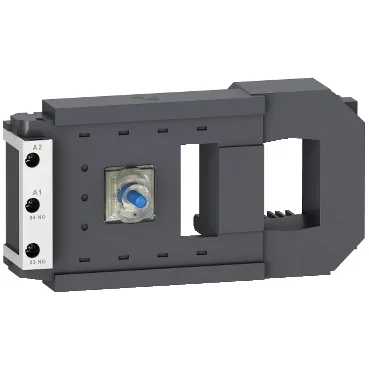
The LX9FG065 is a specific contactor coil from the TeSys F range, designed as a replacement or spare coil for LX9FG contactors. It runs on a 65 V AC control circuit, rated for 40 to 400 Hz, and is classed as a low-consumption coil — meaning the hold-in power draw stays between 8.9 and 10.9 VA once the contactor is sealed. This is a current-production part, so it's still a standard catalog item for new builds and panel spares alike.
The 65 V AC coil voltage is the main selection gate — if your control transformer or control circuit is delivering 65 V AC, this coil matches. The operational limits are 0.85 to 1.1 Uc at 131 °F (55 °C). Drop-out occurs between 0.35 and 0.55 Uc. Opening time is 130 ms, closing time is 35 ms — these are the mechanical response times of the coil itself, not including the main contactor's arc extinction. The maximum operating rate is 2400 cycles per hour at 131 °F (55 °C), so it's suited for moderate-speed cycling applications like conveyor interlocks or pump sequencing, but not for high-speed switching like a welding gun controller. In a typical panel with 10 to 20 operations per hour, that translates to decades of service before the coil itself wears out. Heat dissipation runs 8 to 9.8 W during holding. In a densely packed panel, that heat adds up — account for it in your thermal budget, especially if multiple coils are ganged in the same enclosure without forced ventilation.
Coil characteristics and wiring considerations
This coil comes without a built-in suppressor module. If your control circuit uses solid-state outputs or PLC relay modules, you'll want to add an external RC snubber or varistor across the coil terminals to suppress the inductive kick on dropout. The inrush power is 950 to 1180 VA at 68 °F (20 °C), which is the initial surge when the coil pulls in — your control transformer needs to handle that transient without dipping the rail voltage for other loads on the same circuit. Coil resistance measures 3.38 ohms inrush and 115.6 ohms holding at 68 °F (20 °C). The low holding resistance is what keeps the steady-state power consumption down.
Because this is a specific coil for the LX9FG contactor family, it's a critical spare to keep one in the cabinet if you're running LX9FG contactors in a production line. The active status means you can order it today for both new builds and spares, but the usual procurement advice applies: if your plant has a dozen LX9FG contactors, stocking one spare coil avoids a line-down scenario when a coil fails.