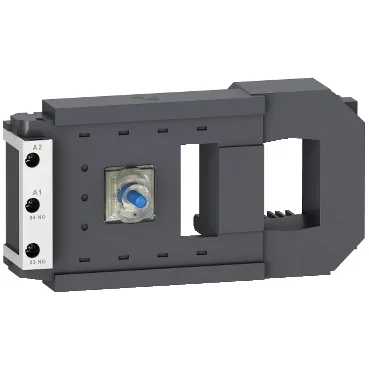
The Schneider Electric LX9FG140 is a specific contactor coil from the TeSys F range, designed to replace the coil in a TeSys F contactor frame. It is a low-consumption AC coil rated for 140 V AC at 40 to 400 Hz, meaning it pulls less steady-state power than a standard AC coil once the contactor is sealed — the inrush is 950 to 1180 VA, but holding drops to 8.9 to 10.9 VA. The coil operates within 0.85 to 1.1 Uc and drops out between 0.35 and 0.55 Uc at 131 °F (55 °C). Opening time is 130 ms, closing time 35 ms. The coil has no built-in suppressor module — if your application needs surge suppression (e.g., driving the coil from a PLC output or in a high-noise panel), you will need to add an external RC snubber or varistor across the coil terminals.
If you are filling a BOM line or keeping a spare for an existing TeSys F contactor in service, the LX9FG140 is the exact coil you need. Because it is obsolete, the procurement posture is: find a sealed surplus unit, verify the coil resistance matches your circuit (16.61 Ω inrush, 667.6 Ω holding at 68 °F), and commit the line against an RFQ. There is no factory lead time to wait for — it is whatever the surplus market holds.
The 140 V AC control voltage is specific — this coil will not work on 120 V or 240 V circuits without a transformer. The low-consumption design means the coil runs cooler than a standard AC coil: heat dissipation is 8 to 9.8 W, which keeps the temperature rise inside the contactor envelope manageable in a crowded panel. If your panel ambient exceeds that, the coil may not hold in reliably — the drop-out voltage shifts with temperature. For outdoor or unheated enclosures in cold climates, the -5 °C lower limit is a constraint.
Deployment context
This coil snaps into a TeSys F contactor frame — the same frame used in motor starters and power switching in industrial control panels. No wiring changes needed if the coil voltage matches the existing control circuit.