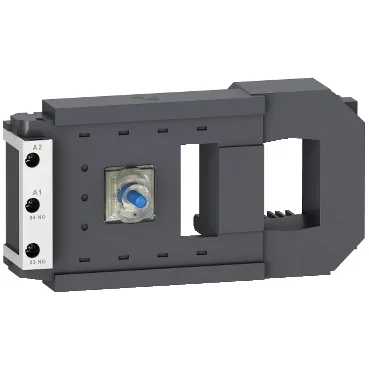
The LX9FG300 is a specific contactor coil for the TeSys F range, designed for 300 V AC control circuits operating at 40 to 400 Hz. It's the low-consumption variant, meaning the hold-in power is kept to 8.9...10.9 VA once the contactor is sealed, while the inrush to pull it in hits 950...1180 VA. That inrush spike matters for transformer sizing and PLC output drive — a standard 24 V DC supply won't cut it; this is an AC coil, and the control transformer needs to handle the initial surge without drooping below the 0.85 Uc operational limit. The coil sits inside a TeSys F contactor frame, replacing or specifying the magnetic actuator that physically closes the main power poles. It's a field-replaceable component, not a sealed assembly — useful for stocking one coil voltage across multiple contactor ratings, or swapping a failed coil without replacing the entire contactor.
Control circuit voltage is 300 V AC, with operational limits of 0.85 to 1.1 Uc at 131 °F (55 °C) — so the coil reliably picks up between 255 V and 330 V. Drop-out happens between 0.2 and 0.55 Uc (60 to 165 V), which is a wide hysteresis band; that means a brownout won't cause chattering, but a hard undervoltage below 60 V will drop the contactor cleanly. The coil resistance tells the story: 82.3 Ω inrush at 68 °F (20 °C) drops to 3169 Ω holding at the same temperature — the built-in economizer circuit shifts from high-current pull-in to low-current hold, which is what keeps the heat dissipation to 8...9.8 W. Operating time is 130 ms opening, 35 ms closing. That's a fast close for arc mitigation on the main contacts, and a deliberately slower open to manage inductive kickback. The maximum operating rate is 2400 cycles per hour at 131 °F (55 °C), which works out to one operation every 1.5 seconds — fine for most motor starting and switching duty, but not for high-speed inverter bypass or rapid cycling applications. That's the coil and contactor mechanism together, assuming proper electrical load within the contactor's rating. In practice, this coil will outlast several sets of main contacts in normal motor-switching duty.
Coil Technology and Installation Notes
This coil is supplied without a built-in suppressor module. That means you need to add an RC snubber or varistor across the coil terminals if the control circuit has sensitive electronics (PLC outputs, solid-state relays) or if you're switching the coil with a contact from the same panel. The 130 ms opening time gives the arc on the coil's own contacts time to extinguish, but the inductive kick from the coil itself can still couple noise into adjacent wiring. A standard 0.1 µF + 100 Ω RC suppressor across A1-A2 cleans that up. The coil operates in ambient temperatures from 23 to 131 °F (-5 to 55 °C). That's the standard industrial enclosure range; no special derating needed for most panel environments. The low-consumption design keeps the self-heating manageable even in a crowded DIN-rail cabinet.