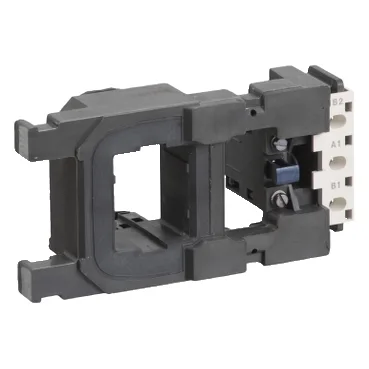
The LX9FH1002 is a specific contactor coil from the Schneider Electric TeSys F range, designed as a replacement or spare coil for TeSys F contactors. It operates on a 100 V AC control circuit at 40...400 Hz and is built for low consumption — meaning less heat dumped into the panel over the duty cycle. The coil draws 560...660 VA inrush at 68 °F (20 °C) and settles to 8...10 VA holding at the same temperature. That inrush-to-hold ratio is typical for AC-operated contactor coils; the holding power is low enough that a standard control transformer can supply multiple coils without sagging the rail. Coil resistance measures 15.11 Ω inrush and 330 Ω holding at 68 °F (20 °C). The wide difference between inrush and holding resistance is what creates the magnetic pull-in force, then drops to a lower holding current to keep the contactor sealed without overheating.
Timing and Thermal Behaviour
Opening time is 25 ms, closing time is 45 ms. That 20 ms difference is normal for AC coils — the closing stroke has to overcome spring force and seat the armature, while opening is just spring return after the coil drops out. Heat dissipation runs 8.4...10.4 W depending on the operating point. That's the power the coil dissipates as heat in the enclosure; if you're packing multiple contactors in a sealed panel, that thermal load adds up and may need derating or forced ventilation above the 131 °F (55 °C) upper ambient limit. That rate is fast enough for most repetitive machine cycles — a conveyor indexing every second, for example — but sustained high-speed switching will heat the coil and reduce the thermal headroom.
Control Voltage and Drop-Out Margins
The coil is rated for 100 V AC control voltage, with operational limits of 0.85...1.1 Uc at 131 °F (55 °C) — so it holds in reliably down to 85 V and up to 110 V. Drop-out occurs between 0.35...0.55 Uc, meaning the contactor releases somewhere between 35 V and 55 V. That wide drop-out band is intentional: it prevents nuisance drop-out from a brief voltage sag, but if your control transformer sags below 35 V, the contactor drops and you lose the load. There is no built-in suppressor module on this coil. That means the inductive kickback from the coil when it de-energizes is unfiltered — you need an external RC snubber or a free-wheeling diode across the coil terminals if your PLC output or relay driving it can't handle the back-EMF. Check the coil suppression requirements against your control circuit before wiring.
Because it is a specific contactor coil — not a universal replacement — verify that the mechanical interface and stroke match the TeSys F contactor frame you are fitting it to. The LX9FH prefix is the coil family for the F frame; the 1002 suffix indicates the 100 V AC variant. If your contactor is a TeSys F model, this is the correct coil. If you are working with a different TeSys frame (D, K, or another), the mechanical fit and electrical ratings differ.