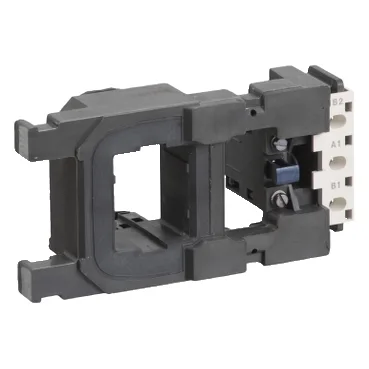
The LX9FH1402 is a replacement coil for the TeSys F contactor range — the big frame, the one that handles motors up to the hundreds-of-amps class. It's a specific coil, meaning it's not a universal retrofit; it's wound for 140 V AC control at 40...400 Hz, low-consumption type. Opening time is 25 ms, closing time 45 ms — that's fast enough for most motor-start and isolation duties, but if you're coordinating with a soft-start or drive bypass, check that the closing delay doesn't overlap with your contactor's own arc-extinction window. Coil holds in at 0.85 to 1.1 times Uc (at 55 °C) and drops out between 0.35 and 0.55 Uc — so on a 140 V AC control circuit, dropout happens somewhere around 49 to 77 V. That's a wide dropout band, which is forgiving for saggy control transformers, but if you need a tight undervoltage release, this isn't it.
No built-in suppressor module on this coil — the evidence flags that explicitly. If your control circuit has a PLC or solid-state output driving this coil, you'll want an external RC snubber or flyback diode across the coil terminals to keep the inductive kick off your logic. Standard practice for AC coils without internal suppression.
Power draw and thermal
Inrush power is 560...660 VA at 20 °C; holding power drops to 8...10 VA. That's a typical low-consumption AC coil profile — high pull-in, low hold. Heat dissipation runs 8.4 to 10.4 W, which means in a dense panel with several TeSys F contactors side by side, you'll want to check the thermal derating for ambient above 55 °C. That's about one cycle per second, continuous — plenty for a cycling conveyor or a press control, but if you're doing high-speed pick-and-place at 2 Hz, you'll wear the contacts before the coil.
Field-fit notes
Coil resistance: 28.9 ohms inrush, 695 ohms holding at 20 °C. That inrush resistance is low enough that the coil draws about 4.8 A peak at 140 V — your control transformer needs to handle that surge without dipping. The holding resistance is high, so steady-state current is around 0.2 A. That's fine for most indoor panels; if this coil lives in a non-conditioned enclosure near a furnace or in a Middle East summer, you'll need to derate or ventilate.