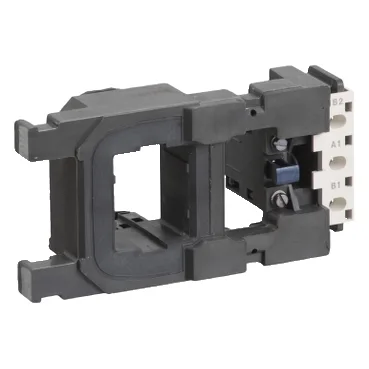
The LX9FH2772 is a specific contactor coil from the TeSys F range, designed to replace or service TeSys F contactors that use a 277-288 V AC 40-400 Hz control circuit. It is a low-consumption coil without a built-in suppressor module, meaning the installer must add an external RC snubber or varistor across the coil terminals if the control circuit requires EMI suppression or if the PLC output driving it needs protection from the inductive kick.
The coil draws 560-660 VA inrush at 68 °F (20 °C) and holds at 8-10 VA. That inrush figure is what the control transformer and the wiring from the panel to the contactor must handle without voltage sag — a 100 VA control transformer won't cut it if multiple coils pull in simultaneously. The holding power is low enough that a standard 24 V DC supply with a relay interface can sustain it, but the inrush transient is the sizing gate. Coil resistance measures 113.1 Ω inrush and 2347 Ω holding at 68 °F (20 °C). The ratio tells you the coil has a series economizer circuit that drops the current after the armature seals — standard for AC-operated contactor coils. The 25 ms opening and 45 ms closing times are typical for a frame this size; the closing time matters if you are sequencing contactors in a star-delta starter to avoid a short-circuit between the two contactors. The control circuit voltage limits are 0.85-1.1 Uc for operation and 0.35-0.55 Uc for drop-out at 131 °F (55 °C). At 277 V nominal, that means the coil picks up reliably down to about 235 V and drops out between 97 and 152 V. If your plant has a weak 277 V lighting circuit that sags under load, the coil may chatter or fail to pick up — a brownout condition on a 277 V lighting panel is a real scenario for this part. Heat dissipation runs 8.4-10.4 W. In a crowded panel with multiple TeSys F contactors, that heat adds up — account for it in the enclosure thermal budget, especially if the contactors are mounted side-by-side with no ventilation gap.
This coil mounts directly onto the TeSys F contactor frame — it is the interchangeable coil assembly, not a separate panel-mounted component. The coil terminals accept ring or fork lugs; verify the wire gauge against the terminal rating on the contactor base. No built-in suppressor means you need to add an external RC suppressor (e.g., the TeSys LA4 series) if the PLC output driving it requires one.