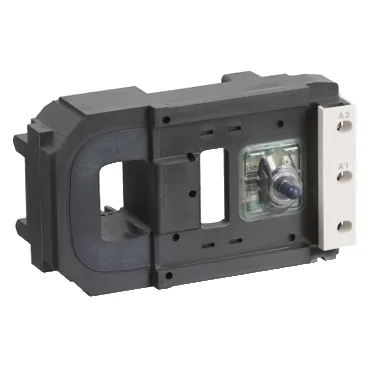
The LX9FJ911 is a specific contactor coil from the TeSys F range, designed to be paired with a TeSys F contactor frame. It is not a standalone contactor — it is the electromagnetic actuator that, when energized, pulls in the contactor's main poles and auxiliary contacts. This is a replacement or spare coil for field servicing or panel builds where the original coil has failed or the control voltage needs to change.
Rated for 25...26 V AC (40-400 Hz) and 25...26 V DC control circuits. That dual AC/DC rating simplifies stocking — one coil covers both control supply types common in mixed panels. The operational voltage window is 0.85 to 1.1 times Uc at 55 °C, so at 26 V nominal the coil holds in from about 22 V to 28.6 V. Drop-out occurs between 0.3 and 0.5 Uc (roughly 7.8 to 13 V), meaning the contactor releases reliably on a sagging DC bus. Opening time is 60 ms; closing time is 20 ms. For a motor starter or resistive load switching, that is standard for a contactor this size. The coil draws 500 VA inrush at 20 °C (40-400 Hz) and holds at 23 VA. The inrush surge matters for control transformer sizing — a 500 VA inrush spike means the control transformer must be rated to handle that transient without dropping the bus voltage below the coil's pick-up threshold. The holding power is modest, so continuous duty heat dissipation stays manageable. Heat dissipation runs 11.4 to 13.9 W. In a sealed or tightly packed panel, that thermal load adds up — account for it in the enclosure's thermal budget, especially if multiple coils are energized continuously. This coil has no built-in suppressor module. An external RC snubber (for AC) or flyback diode (for DC) must be added across the coil terminals to limit voltage spikes when de-energizing. Without it, the inductive kick can damage PLC output cards or relay contacts driving the coil. Average resistance: 4.03 ohms inrush, 43 ohms holding at 20 °C. The inductance of the closed circuit is 0.22 H. These values are useful for calculating peak current and for selecting the suppression components.