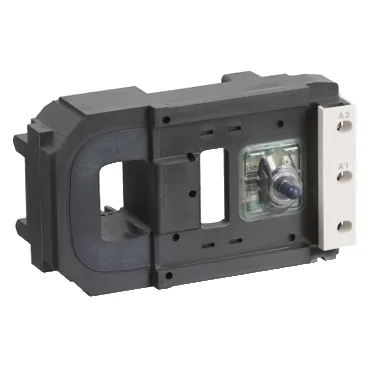
The LX9FJ913 is a specific contactor coil from the TeSys F range, designed as the replacement coil for TeSys F contactors. It is not a standalone contactor — it is the magnetic coil assembly you swap when the original coil fails or when you need to change the control voltage on an existing TeSys F contactor frame. The control circuit accepts 30...32 V AC at 40...400 Hz or 30...32 V DC, with an operational voltage range of 0.85...1.1 Uc at 131 °F (55 °C) and a drop-out threshold of 0.3...0.5 Uc. That means the coil pulls in reliably down to about 25.5 V and drops out cleanly between 9 and 16 V — important to know if your control supply sees brownout conditions on a long cable run. Opening time is 60 ms, closing time is 20 ms. For a contactor coil, that is a standard response — fast enough for motor starting and general switching, but not a high-speed application like a DC injection brake that needs sub-cycle response.
Sourcing and lifecycle — still active, no obsolescence worry
Because it is a current-production part, there is no official successor — the LX9FJ913 is the coil you want for a 30-32 V control circuit on a TeSys F contactor. If you are maintaining a panel with existing TeSys F contactors, this is the direct drop-in replacement.
Heat dissipation runs 11.4 to 13.9 W. That is the heat the coil dumps into the enclosure when energized. In a dense panel with multiple contactors running continuously, that heat adds up — factor it into your enclosure thermal calculation, especially if the panel is sealed or has limited ventilation. Inrush power is 500 VA at 68 °F (20 °C), holding power is 23 VA. The inrush spike is short (the closing time is 20 ms), but your control transformer needs to handle that surge without dropping its output voltage below the coil's pickup threshold. A transformer sized for the sum of holding VA alone will sag on inrush — account for the 500 VA peak. Coil resistance: 4.03 Ω inrush, 43 Ω holding at 68 °F (20 °C). The inductance of the closed circuit is 0.22 H. These numbers matter if you are calculating coil current for fuse sizing or for a PLC output driving the contactor through an interposing relay — the holding current at 32 V DC is about 0.74 A. That is a high endurance figure — this coil should outlast the contactor's electrical life in most motor-switching applications. The maximum operating rate is 3600 cycles per hour at 158 °F (70 °C), which is one cycle per second — fine for rapid cycling like a packaging machine or a stamping press. The coil has no built-in suppressor module. That means the inductive kickback when the coil de-energizes is unsuppressed — you need to add an external flyback diode (for DC) or an RC snubber (for AC) across the coil terminals if you are driving it from a PLC output or a solid-state relay, or you risk damaging the driver.
Operating environment
Ambient air temperature for operation is 23 to 131 °F (-5 to 55 °C). If your panel sits in a non-conditioned space that sees above 131 °F, you need to derate or add forced cooling.