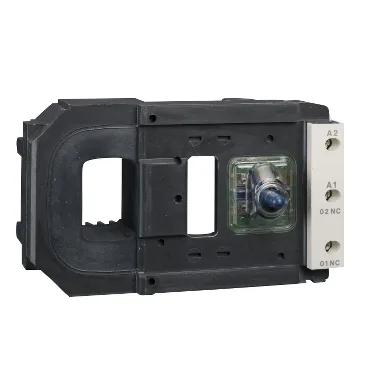
The LX9FJ926 is a specific contactor coil from the TeSys F range, designed to replace the coil in a TeSys F-frame contactor. It's a service part, not a standalone component — you swap it into the contactor when the original coil fails or you need a different control voltage. Rated for 110 V AC and 110 V DC control circuits (50/60 Hz AC, low-consumption DC), it draws an inrush of 430 W at 20 °C and holds at 22 W. The coil resistance measures 32.3 Ω inrush, 302 Ω holding at 20 °C. Opening time is 60 ms, closing 20 ms — fast enough for most motor-starting and general switching duties.
The control circuit accepts AC 40–400 Hz or DC low-consumption drive. The operational voltage window is 0.85 to 1.1 Uc (93.5–121 V for a 110 V coil) at 55 °C; dropout occurs between 0.3 and 0.5 Uc (33–55 V). That's a wide dropout margin — the contactor stays pulled in through a sag down to about half nominal, which is typical for industrial control. Heat dissipation runs 11.4 to 13.9 W depending on coil state. The coil has no built-in suppressor module. If your control circuit uses solid-state outputs or a PLC with sensitive electronics, you'll want to add an external RC snubber or flyback diode across the coil terminals to suppress the inductive kick when it de-energizes.