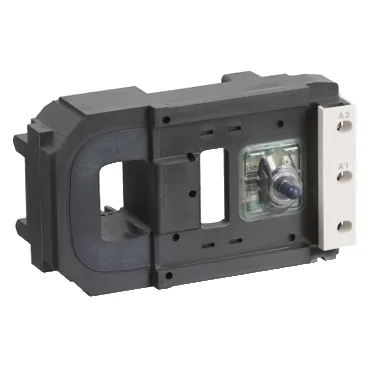
TeSys F contactor coil — what fits where
The LX9FJ935 is a specific contactor coil for the TeSys F range of contactors. It is the replacement coil for the LX9FJ series, designed to be swapped into the contactor body when the control voltage needs to change or the original coil fails. It is not a standalone contactor — it mounts into the TeSys F frame and mates with the armature and main pole assembly. Control voltage is dual-rated: 316...340 V DC and 346...360 V AC at 40...400 Hz. That means the same coil handles both an AC line and a DC bus, common in panels that mix control transformers and battery-backed DC supplies. Operational limits are 0.85...1.1 Uc at 55 °C; dropout occurs between 0.3...0.5 Uc. Opening time is 60 ms, closing time 20 ms. The 60 ms opening is relatively slow for a contactor coil — expect arc extinction to rely on the contactor's own arc chutes rather than a fast coil drop. Not a problem for motor switching, but worth noting if the circuit depends on fast break for fault clearing.
Coil technology and thermal management
This coil has no built-in suppressor module. That means the transient suppression (RC snubber or varistor) must be added externally across the coil terminals if the control circuit uses electronic PLC outputs or solid-state relays. Without it, the inductive kick from coil dropout can damage nearby electronics. Standard practice: fit a diode across the coil for DC circuits, or an RC snubber for AC. Heat dissipation runs 11.4...13.9 W when energized. That is the steady-state thermal load the coil dumps into the contactor body and enclosure. In a tightly packed panel with multiple TeSys F contactors running continuously, that heat adds up — allow natural convection or forced airflow to keep ambient below the 55 °C operating limit. Inrush power is 500 VA at 20 °C across 40...400 Hz; hold-in power drops to 23 VA. The high inrush-to-hold ratio is typical for AC-operated contactor coils — the pickup current saturates the magnetic circuit, then the holding current drops. The control transformer or power supply must deliver the 500 VA peak without voltage sag during pickup.
Mechanical endurance and operating rate
Rated for 10 million mechanical cycles. Maximum operating rate is 3600 cycles per hour at 70 °C. Ambient temperature range for operation is -5...55 °C. The 55 °C ceiling matches the coil's thermal class; above that, the insulation life derates. The coil is rated for a maximum temperature of 70 °C on the operating rate spec, but that is a short-term peak — continuous operation should stay within the -5...55 °C window.
The coil belongs to the LX9FJ device short name family within the TeSys F range. If a buyer needs a different control voltage, the LX9FJ family includes other coil order codes covering various AC and DC ranges.