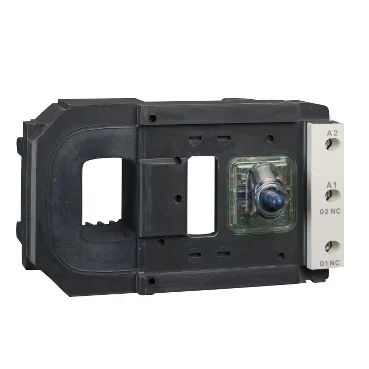
The LX9FK918 is a specific contactor coil for the TeSys F contactor range, wound for 48 V DC/AC low-consumption control. It is the service-replacement coil, not the contactor itself — you swap this onto the existing TeSys F contactor frame when the original coil fails or you need to change the control voltage. Control voltage is 48 V DC and 48 V AC, with an operating band of 0.85...1.1 Uc at 131 °F (55 °C) and a drop-out threshold of 0.3...0.5 Uc at the same temperature. That means the coil holds in reliably down to roughly 41 V and drops out below about 24 V on a 48 V nominal rail — useful to know if your control transformer sags under load. Opening time is 60 ms, closing time 20 ms. For a contactor coil that is standard-speed — not fast enough for synchronous switching, but fine for motor starting or resistive load switching in a panel.
Power draw and thermal budget
Inrush power is 470 W at 68 °F (20 °C), then the hold-in power settles to 29 W at the same temperature. Steady-state heat dissipation runs 15...18.3 W. That is the figure your panel thermal calculation cares about — every coil in a multi-contactor enclosure adds that much heat, so account for it in the enclosure sizing or forced ventilation. The closed-circuit inductance is 0.22 H, which combined with the 48 V DC supply gives a reasonable hold current. No built-in suppressor module is included — you need to add a free-wheeling diode or RC snubber across the coil if your PLC output or relay driving it does not already have one. Without suppression the inductive kick can weld relay contacts or damage solid-state outputs.
Mechanical endurance and cycling
At that rate the coil would hit its mechanical life in about 2800 hours of continuous cycling — fine for occasional switching, but if this coil is in a machine that cycles every few seconds you will be replacing it annually. For typical motor starting duty (a few cycles per hour) the 10 Mcycles figure is effectively a lifetime rating. Ambient operating temperature range is 23...131 °F (-5...55 °C).