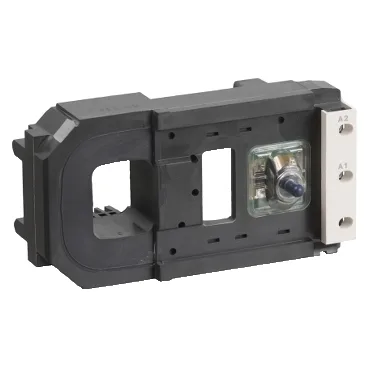
The LX9FK929 is a specific contactor coil from the Schneider Electric TeSys F range, designed as a replacement or spare coil for TeSys F contactors. It operates on a 157...175 V DC control circuit and is classed as low consumption, meaning it draws less steady-state power than standard AC coils of the same frame size. The coil has an opening time of 60 ms and a closing time of 50 ms, which governs how fast the contactor responds to a control signal. For a line-side disconnect or motor-start application, that 50 ms close is fast enough for most conveyor and pump starts; the 60 ms open is the figure to check if you need rapid drop-out for an emergency-stop circuit. It is supplied without a built-in suppressor module (coil technology: Without built-in suppressor module), so you will need to add an external RC snubber or varistor across the coil if driving it from a PLC output or solid-state relay that is sensitive to back-EMF.
It belongs to the TeSys F range, which is a well-established contactor platform. If you are freezing a BOM that uses TeSys F contactors, this coil is the direct fit for the 157...175 V DC control voltage variant.
Electrical characteristics at a glance
Inrush power is 550 VA at 20 °C (68 °F), which is the peak the control transformer or power supply must deliver during coil pickup. Once held in, consumption drops to 31 VA at the same temperature — the low-consumption design reduces heat buildup inside the panel. Heat dissipation runs 15...18.3 W during continuous operation. In a densely packed enclosure with multiple contactors, that heat load adds up and may require derating or forced ventilation if the ambient is near the 55 °C upper limit. The control circuit accepts both AC (40...400 Hz) and DC low-consumption drive, but the rated control voltage of 157...175 V DC is the specific band for this order code. Operational limits are 0.85...1.1 Uc at 55 °C (131 °F), and drop-out occurs at 0.3...0.5 Uc — meaning the coil will release the contactor when the voltage falls below about 47...78 V DC.
Mechanical endurance and operating rate
Maximum operating rate is 3600 cycles per hour at 70 °C (158 °F), so it can handle high-speed indexing or rapid start-stop sequences if the contactor itself is rated for the load.