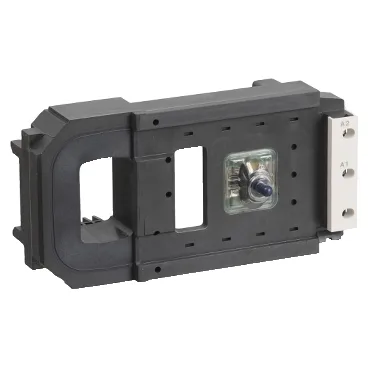
The LX9FL919 is a specific contactor coil from the TeSys F range, designed as the replacement coil for TeSys F contactors. It operates on a 52...58 V DC control circuit, low-consumption type, drawing 48 W hold-in power at 68 °F (20 °C) with an inrush of 733 W at the same temperature. Coil technology is without built-in suppressor module, so you'll need to add external flyback suppression (diode or RC snubber) across the coil terminals if driving from a PLC output or electronic controller. The control circuit accepts both AC 40...400 Hz and DC low-consumption drive.
Opening time is 60 ms, closing time 20 ms — fast enough for general motor switching but not for high-speed synchronous transfer applications. The 5 Mcycles mechanical durability means this coil will outlast most contactor main contacts in normal cycling duty; the limiting factor in service will be the contactor's electrical life at the switched load. Heat dissipation runs 22.8...27.8 W continuous. In a dense panel with multiple TeSys F contactors side by side, that adds up — allow natural convection spacing or forced airflow to keep the ambient within the -5...55 °C operating range. Maximum operating rate is 1800 cycles/hour at 158 °F (70 °C), which is the coil's thermal limit, not the contactor's. Control voltage limits: operational range is 0.85...1.1 Uc at 131 °F (55 °C), so for a 52...58 V DC coil the pickup voltage is around 44...49 V DC minimum. Drop-out occurs at 0.3...0.5 Uc, meaning the coil releases between roughly 15.6 and 29 V DC — important to verify if your control supply has a slow decay or shared DC bus with other loads.
If you're standardizing a panel design, the practical path is to evaluate the current TeSys F coil offering from the same range at the required control voltage and contactor frame size. The mechanical interface (mounting, core geometry) is consistent within the TeSys F family, but coil voltage options have shifted — verify the new order code against your contactor's catalog number before committing.