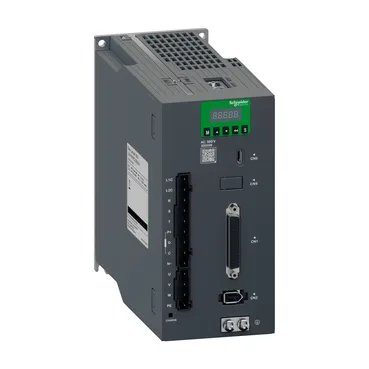
Power rating and output current — what the numbers mean for your axis
The LXM18MPDU30N4X: This drive delivers 3.0 kW nominal at 380-440 V three-phase input with an 8 kHz switching frequency — that's the continuous power you can count on for a servo axis running a typical load cycle, not just a nameplate max. Continuous output current is 11.9 A at 8 kHz, with a 3-second peak of 29.8 A for acceleration and deceleration transients. The peak-to-continuous ratio tells you the drive can handle a 2.5x overload for short moves, which is what you need for real-world positioning profiles where the motor sees intermittent high-torque demands. Line current draw is 8 A at 380-440 V — use this to size the upstream protection and supply wiring, not the motor current. The supply frequency tolerance is 50/60 Hz ±5%, with a network frequency range of 47.5-63 Hz covering most industrial mains.
No EMC filter — plan your cabinet layout accordingly
This variant ships without an integrated EMC filter. That means you need to budget panel space and cost for an external filter if the installation must meet CE emission limits — common in European machine builds or any site with sensitive electronics nearby. The compact housing format (80 mm wide, 170 mm tall, 183 mm deep) leaves room for the external filter alongside on the DIN rail or backplate, but the filter footprint is on you. IP20 protection means this drive lives inside a cabinet — no washdown or dust exposure allowed. Operating ambient is 0-45 °C; above that, derate output current per the standard curve or add forced ventilation.
Communication and I/O — Modbus, analog, and pulse train interface
The drive integrates Modbus RTU, analog I/O (likely 0-10 V or 4-20 mA for speed/torque reference), plus PTI/PTO pulse-train input for step-and-direction control from a PLC or motion controller. This gives you three control paths without an option card: fieldbus for networked axes, analog for simple speed pots, and pulse train for legacy indexer interfaces. The Easy Lexium 18 series is positioned as a straightforward servo drive for basic to mid-complexity motion — think conveyor indexing, pick-and-place, or winding where you don't need full EtherCAT or CANopen but still want digital comms.
Active production and sourcing — no obsolescence worry
No minimum order restriction for single-unit replacements, but volume pricing and lead time are quoted per request.