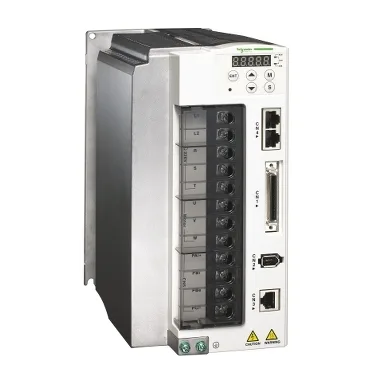
The LXM23AU55M3X is a motion servo drive from the Schneider Lexium 23 Plus range, in the compact book-format footprint — the class of panel-mounted amplifier that commands a brushless servo motor's torque, speed and position loops from a higher-level controller over a fieldbus such as CAN. It is sized for a 5.5 kW continuous shaft load at 220 V three-phase, so it sits in the mid-power slice of the Lexium 23 family — enough to drive machine-tool spindles, packaging indexers and web-handling lines where a single drive axes a sizeable servo without resorting to a larger-frame amplifier.
Supply envelope and output current
Rated supply is 220 V three-phase with a -20 to +15 % tolerance, which corresponds to the documented 170...255 V limits; pairing with a 50/60 Hz mains at a ±5 % frequency window means the drive accepts the common 47.5...63 Hz range found on factory feeds and generator-backed panels alike. Continuous output current is 40 A, which on a 220 V three-phase drive carrying 5.5 kW continuous power is the figure that governs thermal sizing — the integrators should treat it as the safe continuous axis current before tripping into the drive's short-term overload region. Maximum leakage current is 3.5 mA, which dictates the type of residual-current device upstream — a 30 mA RCD is the usual first check, but the design manual should be consulted for any installation where leakage budgets are tight.
Altitude derating and cabinet placement
Between 1000 m and 2000 m of installation altitude, continuous power derates by 1 % per 100 m — at 1500 m the continuous rating is already down roughly 5 %, so a panel builder in an elevated plant needs to budget headroom or derate the load rather than rely on the headline 5.5 kW figure. The book format keeps a narrow cabinet footprint on the DIN rail or backplane row, leaving clearance beside the drive for wiring duct and the braking resistor cable run when the application needs dynamic stopping.
The LXM23AU55M3X is listed as Obsolete at the manufacturer level — production has ended, and a same-code replacement from Schneider is no longer available through the standard new-unit channel. For a line still using this drive, the practical supply path is independent distribution against an RFQ: lot-traced surplus or factory-original inventory sourced quote-by-quote, with availability and the unit price confirmed only at quote time. The drive's functionality is unchanged — it still runs the same motor, the same CAN map and the same commissioning profile — but the buyer is buying from a finite, lot-specific stock pool rather than an open production line.