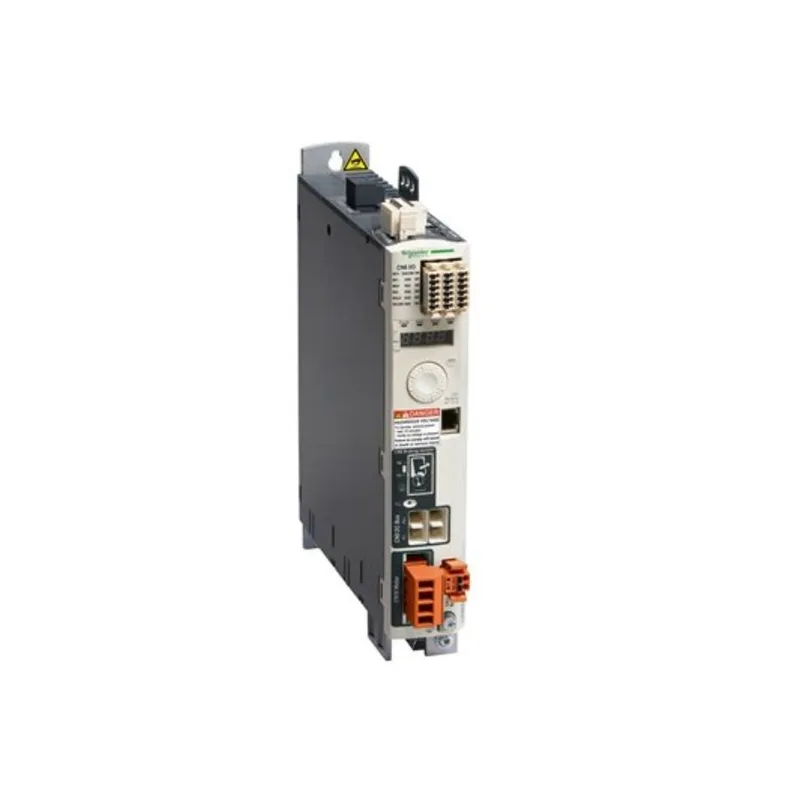
The LXM32CD72N4 delivers 7 kW nominal at both 400 V and 480 V with an 8 kHz switching frequency, and 5 kW at 208 V. That 7 kW figure is the continuous mechanical power you can expect into the motor shaft at rated conditions — not a peak marketing number. Continuous output current is 24 A at 8 kHz, and the drive can deliver 72 A peak for 5 seconds at 208 V or 480 V. The 3:1 peak-to-continuous ratio is typical for servo applications that need high torque during acceleration or deceleration cycles — think indexing tables or press feeds. Line current draw depends heavily on whether you fit an external line choke. At 400 V with a 1 mH choke, the drive draws 22.5 A at 45 % load; without the choke, the same condition pulls 17.3 A but at 126 % load — the choke smooths the input harmonics and reduces the RMS current burden on the upstream supply.
The drive accepts 200–240 V and 380–480 V supplies, three-phase, with a tolerance of -15 % / +10 %. The book format means it mounts flat against a backplate or DIN rail, and the integrated EMC filter saves a separate external filter for most installations — just keep the motor cable shielded and bonded at both ends. Overvoltage category III means it's rated for fixed-installation distribution-level transients — no additional surge suppression needed in a standard industrial panel. Maximum leakage current is 30 mA — this matters for residual-current device (RCD) selection upstream. A Type B RCD is recommended because the drive's switching frequency can generate DC fault currents that blind standard AC types.