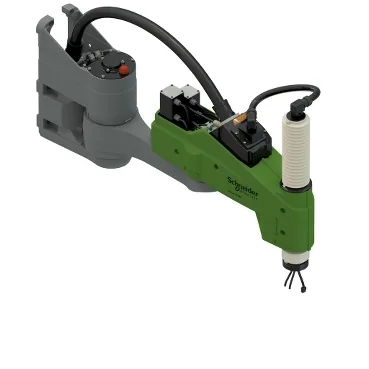
Wall-mounted SCARA in the PacDrive 3 line
The LXMSTS80W300000: Its operating envelope reads 0…200 mm vertically and 0…1600 mm horizontally, with rotational clearance through 360° — that is the working volume the cell layout must budget before the bracket goes on the wall.
Motion budget across the four axes
Nominal angular speeds land at 1200°/s on axis 4, 500°/s on axis 2, and 350°/s on axis 1, with ceilings of 1929°/s, 585°/s, and 490°/s respectively; maximum actuation rates on the linear axes hit 2220 mm/s on axis 3 and 10.62 m/s on axes 1 and 2. Nominal linear speeds of 8.11 m/s on the horizontal axes and 1600 mm/s on the vertical axis are the figures the cycle-time calculator actually runs against.
Lifecycle reality and the spare-parts question
The PacDrive 3 STS80 generation has been retired, which means cells still running this robot are now dependent on independent distribution for replacement arms, ball-screw sub-assemblies, and the integrated user I/O cable.
Drop-in replacement or field repair
Because the configuration string (wall mount, 200 mm ball screw, 200 mm bellows, user I/O cable) is encoded in the part number itself, a direct substitute has to match all four parameters — otherwise the mechanical envelope and the controller handshake on the PacDrive 3 backplane will not line up. For a line that is still in service, the practical options are surplus stock pulled from the independent channel or a repair-exchange on the failed axis assembly, both of which are quoted to order against the specific cell's BOM.