Accuracy and measurement scope
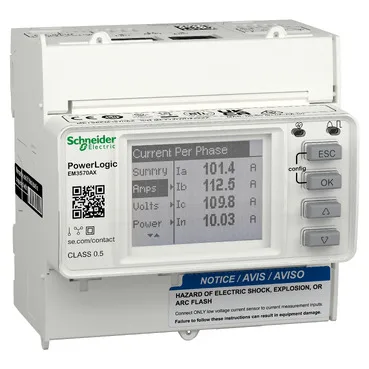
Rated Class 0.5 for both active energy and power per IEC 61557-12 and ANSI C12.20, this meter delivers ±0.5 % on voltage, current, active/reactive/apparent energy, and power factor — the kind of repeatability that holds up in a billing-grade sub-meter. It measures per-phase and total active, reactive, and apparent power, plus peak demand (P, Q, S), voltage (L-L and L-N), current (I1, I2, I3, Iavg), frequency, and calculated neutral current. The four-quadrant energy registration handles import/export and bidirectional flows. Demand intervals can be sliding, fixed, or rolling block, and externally synchronised via the communication port — useful for aligning with utility billing windows.
Installation and wiring notes
Clip-on DIN-rail mount saves panel space — the housing is 90 mm wide, 91.4 mm tall, and 70.6 mm deep. That's a standard 4-module width on a DIN rail, so it fits alongside breakers and contactors without crowding the gland plate. Torque specs are tight: voltage and input circuits at 4.4 lbf·in (0.5 N·m), current and supply circuits at 7.08 lbf·in (0.8 N·m). A small torque screwdriver is the right tool — don't guess it. The relay output (one form-C) can be wired for alarm or pulse output; the orange LED on the front panel gives a local visual alarm, and the green LED confirms the operating state.
Compliance coverage is broad: IEC 61557-12, IEC 61326-1, IEC 61010-1, IEC 61010-2-30, plus UL 61010-1, UL 61010-2-30, UL 2808, and CSA C22.2 No. 61010-1-12. Pollution degree 2, indoor use only, operating altitude up to 3000 m. Communication includes Syslog protocol support and web services for real-time data viewing, network and protocol setting, and IP filtering — handy for remote monitoring without a separate gateway.