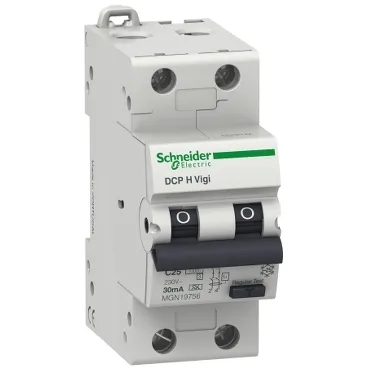
It carries a 16 A rated current on a C-curve (magnetic trip 5–10× In) and integrates 30 mA earth-leakage protection, so one device covers both overcurrent and ground-fault protection for a final subcircuit. The 10 kA breaking capacity at 230/240 V AC (Icn per EN/IEC 61009-2-1) is sized for standard distribution boards in residential and light commercial panels — not for high-fault industrial switchgear, but adequate for the Acti9 board it clips into.
What sets the DCP Vigi apart from a separate MCB + RCCD pair is the thermal-magnetic trip and the residual-current sense share a single housing and a common mechanism. That saves one DIN module (2P vs 4P for discrete devices) and eliminates the risk of an uncoordinated trip between two separate units. The 30 mA sensitivity is the standard for personnel protection (shock risk) per IEC 60364, not equipment-protection levels like 100 or 300 mA. If the circuit needs selectivity with downstream 10 mA RCDs, the 30 mA is the upstream choice — but for a final subcircuit feeding socket outlets or lighting, 30 mA is the default.
Tunnel terminals accept 1–35 mm² rigid or 1–25 mm² flexible, with a 2 N·m tightening torque and 12 mm strip length. IP20 on the body, IP40 inside a modular enclosure. The toggle indicates ON, OFF, and fault-trip positions; the unit is non-padlockable, so if lockout/tagout is required, the upstream isolating switch or a padlockable MCB must be used.