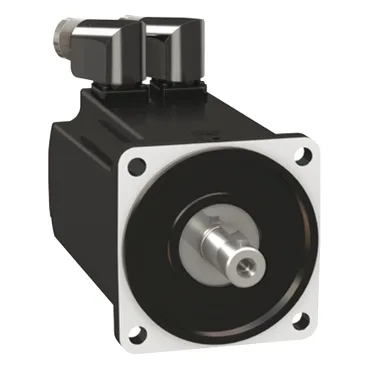
What this servo motor's ratings mean for your axis design
The MH31001P16A2200: This MH3 series motor delivers 1520 W continuous power and a nominal torque of 3.3 N·m at 115 V three-phase supply, derating to 2.9 N·m at 480 V. The torque constant of 1.09 N·m/A at 120°C hot copper tells you the drive current needed for a given torque target — at the continuous stall current of 3.15 A, you get 3.4 N·m continuous stall torque. That's the holding torque at zero speed without a brake. The single-turn SinCos Hiperface encoder provides absolute position within one revolution — no homing sequence needed on power-up for rotary axes that stay within 360°. The 10 motor poles give a finer torque ripple than an 8-pole design, but the feedback resolution must match the drive's Hiperface interface; not all servo drives support this protocol.
Mounting and cooling — what the flange and IP rating mean on the line
The 100 mm international standard flange with a 95 mm centring collar and 9 mm mounting holes on a 4-hole pattern bolts directly to standard NEMA 100 mm or IEC 100 mm motor mounts. The centring collar depth is 3.5 mm — the pilot engages fully before the bolts take shear. The rotatable right-angled connectors let you route the power and feedback cables in tight enclosures without bending the cable beyond its minimum radius. Natural convection cooling means no fan — the thermal budget is entirely passive. The 1520 W continuous power is achievable only when the motor is mounted to a heat-sinking metal surface; in free air with restricted airflow, derate the continuous torque by 20-30% depending on ambient temperature. The maximum radial force at the shaft drops from 900 N at 1000 rpm to 530 N at 5000 rpm — bearing life is governed by this force-speed curve, not just the static load rating.
The MH3 series is Schneider's compact servo motor line for the Lexium 52 and 62 drive families. The sizing reference MH31001P indicates the motor frame and winding variant — confirm the mating drive model and cable set from the same series to ensure the Hiperface encoder interface and power connector pinout match.