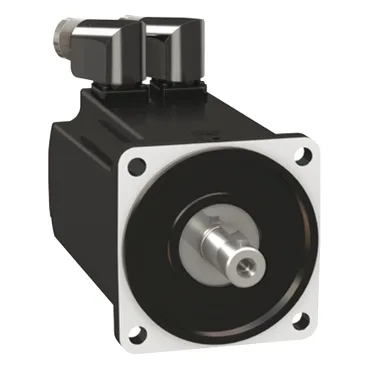
4000 rpm servo with holding brake — MH31002P02F2200
The MH31002P02F2200 is a three-phase servo motor from the MH3 series, rated for 4000 rpm nominal speed and 2270 W continuous power. It carries a holding brake rated at 5.5 N.m, so the load stays locked when the drive is off — no Z-axis drift on a vertical axis. The nominal torque depends on the drive voltage and phase configuration: 5.67 N.m with an LXM52 or LXM62 at 115 V three-phase, dropping to 4.2 N.m at 480 V three-phase. Match the drive voltage to the BOM before committing the motor. The encoder is a Multiturn SinCos Hiperface — absolute position feedback with 4096 revolutions multiturn resolution. No homing cycle needed after a power cycle; the controller reads the position directly from the encoder.
Torque, inertia, and mechanical limits
The torque constant is 1.19 N.m/A at 120 °C copper temperature — use this to calculate the current required for a given torque demand. Stator resistance is 1.97 Ohm and inductance is 8.24 mH, which sets the electrical time constant and the drive's current loop tuning. Maximum radial force on the shaft derates with speed: 990 N at 1000 rpm, 620 N at 4000 rpm. If the motor drives a belt or pulley, the radial load at operating speed must stay below this curve.
Mounting and environmental sealing
The motor flange is 100 mm (3.9 in) with a centring collar diameter of 95 mm and a depth of 3.5 mm — standard IEC mounting pattern. The smooth shaft is 19 mm diameter and 40 mm long; no keyway, so the coupling must clamp directly on the shaft. IP65 rating means the motor body is dust-tight and protected against water jets from any direction. The rotatable right-angled connectors let the cable exit point be oriented during installation — useful in tight cabinets where straight connectors would interfere with the enclosure wall. Natural convection cooling — no fan, so the motor relies on its own surface area and the mounting flange to dissipate heat. The hot-spot copper temperature is rated at 135 °C; the continuous torque rating assumes that limit is not exceeded.