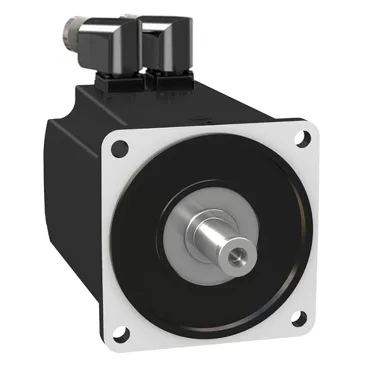
Motor sizing and supply constraints
The MH31401P02A2200 is a three-phase servo motor rated for 2640 W continuous power at a nominal speed of 3500 rpm, with a maximum mechanical speed of 4000 rpm. Continuous stall torque is 10.3 N.m (91.2 lbf.in) at 8.58 A continuous stall current — this is the holding torque at zero speed and the baseline for sizing the mating drive's continuous current rating. Peak stall torque reaches 39.9 N.m (353.1 lbf.in) across the 115–480 V three-phase range, which governs acceleration torque and the drive's peak current capability requirement. The torque constant is 1.16 N.m/A at 120 °C copper temperature, so the drive current setpoint maps directly to shaft torque — useful for feed-forward torque control loops.
Encoder feedback and mechanical interface
Feedback comes from a Multiturn SinCos Hiperface encoder — this provides absolute position over multiple revolutions without a battery-backed counter, so the controller knows the shaft position immediately on power-up. The shaft is smooth (no keyway) with a 24 mm diameter and 50 mm length, and there is no second shaft end — direct coupling only, no provision for an external encoder or brake on the rear. Motor flange size is 140 mm (5.5 in) with a centring collar diameter of 130 mm and 3.5 mm depth — this matches the standard IEC mounting pattern for this frame size. Electrical connection uses rotatable right-angled connectors, which helps route cables in tight cabinet layouts without bending the cable beyond its minimum radius.
Environmental protection and thermal management
The motor carries an IP65 standard rating — the enclosure is dust-tight and protected against water jets, so it can be mounted in washdown zones or areas with airborne particulates without an additional cover. Cooling is by natural convection — no integrated fan, so the continuous torque rating assumes free air movement around the motor body. Forced cooling may be needed if the motor is enclosed or mounted in a still-air pocket. Maximum radial force at the shaft varies with speed: 1930 N at 1000 rpm, 1530 N at 2000 rpm, 1340 N at 3000 rpm — belt-driven loads must stay within these limits to avoid bearing overload.