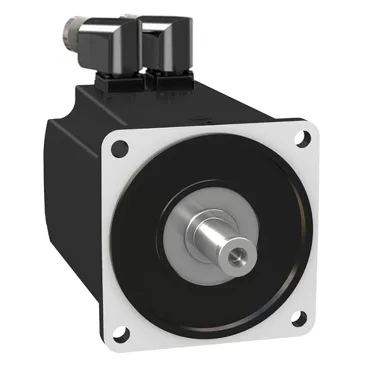
Motor specs that matter for the BOM line
The MH31401P11A2200: This is a three-phase servo motor from the MH3 series, rated 2.64 kW continuous power at 400/480 V three-phase input — the nominal torque sits at 9.36 N·m when paired with an LXM52 or LXM62 drive at 115 V, and drops to 7.22 N·m at 400/480 V. Speed range is 1000–3500 rpm depending on drive voltage and phase configuration; the maximum mechanical speed is 4000 rpm, so the motor can overshoot the nominal ceiling by about 14% before the bearings or rotor limit kick in. Peak stall torque hits 39.9 N·m across the 115–480 V three-phase range — that's about 4.3× the nominal torque at 400 V, which gives headroom for acceleration and load transients without tripping the drive's current limit. Continuous stall torque is 10.3 N·m at 8.58 A stall current, so the motor holds position under load without overheating as long as the drive's I²t protection is set correctly.
Encoder, feedback, and mounting constraints
The single-turn SinCos Hiperface encoder gives absolute position within one revolution — no homing sequence needed on power-up for single-turn applications, but multi-turn setups will need a separate multiturn encoder or a homing routine. The motor flange is 140 mm (5.5 in) with a 130 mm centring collar and four mounting holes on an 11 mm diameter — standard IEC metric pattern, so it bolts onto most common gearbox and machine frames without adapter plates. Shaft is 24 mm diameter with a parallel key, 50 mm shaft length — a common size for direct coupling to ball screws or timing-belt pulleys; the maximum radial force at 1000 rpm is 1930 N, dropping to 1340 N at 3000 rpm, so belt tension needs to stay within those limits.
IP65 and cooling — where it runs
IP65 rating means the motor body is dust-tight and protected against low-pressure water jets — suitable for washdown areas in food processing or machining coolant splash, but not for submersion or high-pressure spray (IP69K would be needed for that). Cooling is natural convection — no fan or liquid circuit, so the motor relies on its own surface area and the machine frame for heat dissipation; in a confined enclosure or high-ambient environment, derate the continuous torque or add forced airflow. Stator resistance is 0.69 Ω and inductance 6.72 mH — the electrical time constant is about 9.7 ms, which sets a lower bound on the PWM carrier frequency the drive can use without excessive ripple current.
Lifecycle and sourcing — active, quoted to order
No holding brake on this variant (MH31401P11A2200 ends with '0' for without brake) — if the application requires a brake for vertical-axis holding, the '1' suffix variant is the one to source.