Motor ratings and what they mean for the axis
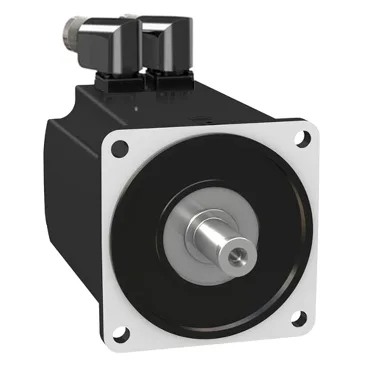
The MH31401P11F2200 is a three-phase servo motor from the MH3 series, delivering 2.64 kW continuous power. The nominal torque is 9.36 Nm when driven by an LXM52 or LXM62 servo drive at 115 V three-phase, and 7.22 Nm at 400/480 V three-phase. That torque spread tells you the motor's output is supply-voltage dependent — match the drive's bus voltage to the torque you need at the spindle. Peak stall torque is 39.9 Nm across 115–480 V three-phase, and continuous stall torque is 10.3 Nm. The 8.58 A continuous stall current and 29.8 A maximum current define the drive's current-loop ceiling — size the drive for at least 30 A peak to use the motor's full overload capability.
Brake and encoder — what holds and what reports position
The holding brake delivers 18 Nm and pulls in at 18 W. That brake is sized to hold the vertical axis at standstill with the rated load; it is not a dynamic brake — do not engage it while the motor is spinning. The 18 W coil means the brake release voltage is typically 24 VDC; confirm the drive's brake output can source that current. The single-turn SinCos Hiperface encoder gives absolute position within one revolution. For multi-turn applications (conveyors, ballscrews with more than one turn of travel), this motor needs an external multi-turn battery backup or a different encoder option. The Hiperface protocol is compatible with Lexium 52 and 62 drives natively.
Mounting and environmental fit
The motor has an international standard flange with a 140 mm (5.5 in) flange size and a 130 mm centring collar. The shaft is 24 mm diameter with a parallel key, 50 mm shaft length. The centring collar depth is 3.5 mm — ensure the mating pilot bore depth matches to avoid axial misalignment. IP65 protection means the motor body is dust-tight and protected against low-pressure water jets — suitable for washdown areas but not submerged. Cooling is by natural convection, so keep the ambient temperature below 40 °C and allow free air movement around the fins. The electrical connection uses rotatable right-angled connectors, which helps in tight cable trays or when the motor is mounted close to a machine frame. The connectors can be rotated before tightening the cable gland.