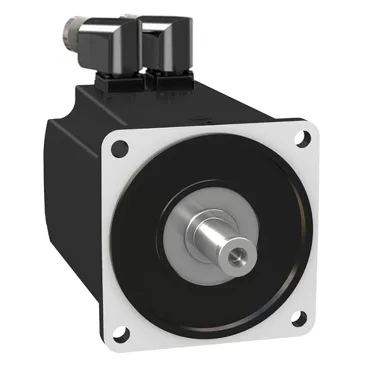
The MH31402P01A2200 is a three-phase servo motor from Schneider Electric's MH3 series, delivering 3.73 kW continuous power at 3000 rpm nominal speed. That power rating is the sustained output the motor can hold without exceeding the thermal limit of the winding insulation — it's the figure you size the drive and the mechanical load against for continuous-duty applications like conveyors or spindle drives. Nominal torque is 16.34 N.m when paired with an LXM52 or LXM62 drive at 115 V three-phase input; at 400 V or 480 V three-phase the same motor delivers 10.17 N.m. The torque constant is 1.24 N.m/A at 120 °C winding temperature, so the actual torque available at the shaft depends on the current the drive can supply and the thermal state of the motor. Peak stall torque reaches 55.5 N.m across the 115–480 V three-phase range — this is the short-duration torque available for acceleration or overcoming a jam, limited by the 46.22 A peak current capability. Continuous stall torque is 18.5 N.m, sustained indefinitely at standstill without overheating. The single-turn SinCos Hiperface encoder provides absolute position feedback within one mechanical revolution — no homing sequence needed on power-up for applications that don't require multi-turn tracking. The smooth shaft (no keyway) means the coupling or pulley must be secured with a clamping or friction-fit method; there is no key to transmit torque.
IP65, natural convection, and mechanical limits
IP65 protection means the motor body is sealed against dust ingress and low-pressure water jets — suitable for washdown environments in food processing or packaging lines where the motor is hosed down but not submerged. The cooling method is natural convection (no fan), so the motor relies on its own surface area to dissipate heat; derate the continuous power if mounted in a confined space or near heat sources. Maximum mechanical speed is 4000 rpm — the rotor and bearings are rated for that ceiling, but the nominal speed is 3000 rpm. The maximum radial force at the shaft end is 2240 N at 1000 rpm, dropping to 1550 N at 3000 rpm; a belt drive or direct coupling must stay within these limits to avoid bearing overload. The motor flange is an international standard 140 mm flange with a 130 mm centring collar and 11 mm mounting holes. The centring collar depth is 3.5 mm — the mating pilot on the gearbox or machine frame must engage this collar to centre the shaft correctly. Overall length is 192 mm (7.6 in) from the mounting face to the rear of the housing.
Electrical connections use rotatable right-angled connectors, which let the cable exit in any of four directions — useful when the motor is mounted in a tight cabinet or on a moving axis where the cable must route without sharp bends. The stator resistance is 0.23 Ω and inductance is 2.99 mH; these values matter for the drive's current-loop tuning and for estimating copper losses at full load.