Sizing the motor to the load — continuous power and torque profile
The MH31402P11A2200 delivers 3.73 kW continuous power at 400/480 V three-phase, with a nominal torque of 16.34 N·m at 1000 rpm. That torque figure drops to 10.17 N·m at 3500 rpm — the constant-power region starts above base speed, so the load's torque demand at high speed must stay within that envelope. Continuous stall torque is 18.5 N·m at 16.83 A stall current — this is the holding torque at zero speed, useful for indexing or vertical-axis applications where the load must be held at rest without a brake.
Feedback and connectivity — encoder type and cable routing
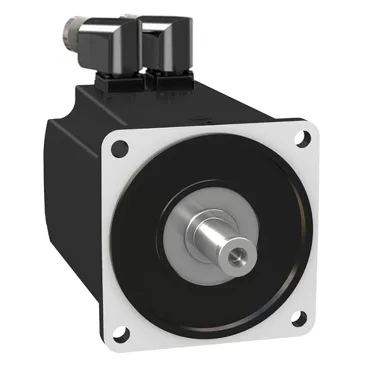
Single-turn SinCos Hiperface encoder provides absolute position feedback over one revolution — the drive knows the rotor angle at power-up without a homing move, as long as the application stays within one turn. For multi-turn applications, a different encoder variant or external homing is needed. Rotatable right-angled connectors let the power and feedback cables exit in any of four orientations — useful when the motor is mounted in a tight cabinet or against a machine frame where straight connectors would interfere.
Mechanical fit — flange, shaft, and mounting dimensions
140 mm flange with a 130 mm centring collar and four 11 mm mounting holes — this is the standard IEC B5 (FF) flange pattern for motors in this power class. The 24 mm shaft with a parallel key and 50 mm shaft length couples to most standard gearboxes and pulleys. Overall length is 192 mm (7.6 in) — compact for a 3.7 kW motor, but account for the connector protrusion when laying out the enclosure. No second shaft end, so no provision for a separate encoder or tachometer on the rear. Maximum radial force at the shaft is 2240 N at 1000 rpm, dropping to 1550 N at 3000 rpm — belt-drive applications must stay within these limits to avoid bearing overload.
Thermal management — natural convection and winding protection
Natural convection cooling — no internal fan, so the motor relies on ambient airflow and the mounting surface for heat dissipation. In a still-air cabinet or at low speeds, the duty cycle must be derated; the stator resistance is 0.23 Ω and inductance 2.99 mH, so I²R losses at 16.83 A stall current are about 65 W. Maximum winding temperature is 135 °C (275 °F) hot-spot — the torque constant is specified at 120 °C (248 °F), so expect some torque drop if the motor runs near its thermal limit. The back-EMF constant is 70.7 V/krpm, which sets the bus voltage needed to reach rated speed.
No holding brake on this variant. If the application requires a brake for vertical-axis holding or emergency stop, specify the brake-equipped version of this frame size. The motor mates with Lexium 52 or 62 drives — the nominal speed and torque curves are listed for both drive families at various supply voltages.