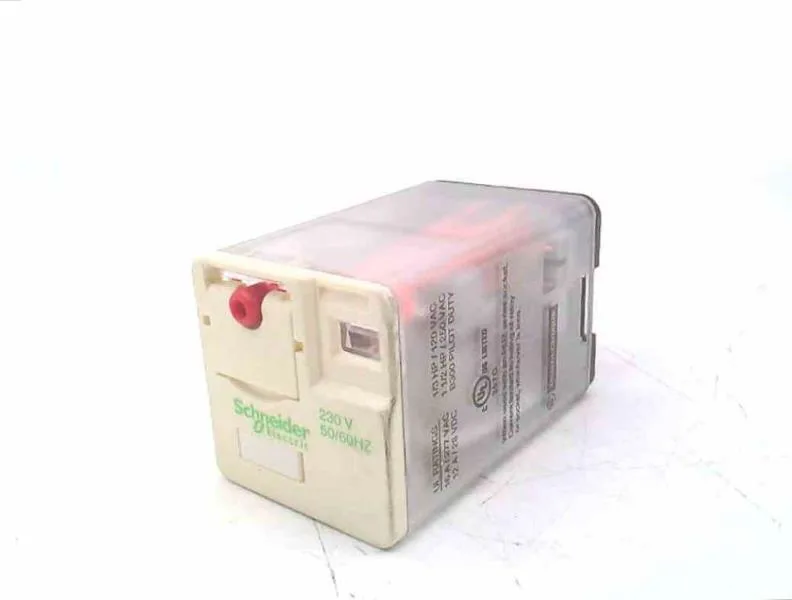
The Schneider Electric RUMC3AB1P7 is a Harmony RUM-series plug-in relay with a 230 V AC coil and three changeover (3 C/O) contacts rated 10 A in AC-1/DC-1 duty per IEC. It's the standard ice-cube form factor — cylindrical pins, fits the common RUM socket — and carries a lockable test button so you can manually latch the contacts during commissioning without wiring a jumper.
The 10 A AC-1/DC-1 rating (NO contacts) covers resistive loads like heaters and incandescent lamps; the NC contacts are rated 5 A in the same duty class. For motor or inductive loads, you'll need to derate — the utilisation coefficient is listed at 20 %, meaning the relay is designed to switch at 20 % of its rated current under typical inductive conditions. The AgNi contacts handle moderate inrush, but for high-surge loads like solenoid valves, consider a relay with AgSnO2 contacts. Minimum switching capacity is 170 mW at 17 V / 10 mA — important if you're switching low-level signals from a PLC or sensor. Below that threshold, the contact film may not break, causing intermittent opens. The relay switches in 20 ms typical, so it's fast enough for general-purpose logic but not for high-speed counting (max 1200 cycles/hour under load). Coil consumption is 2...3 VA at 60 Hz, and the dropout threshold is ≥ 0.15 Uc AC — so the relay holds in down to about 34.5 V AC and drops out reliably below that. The 7200 Ω coil resistance at 20 °C (±15 %) helps with thermal budgeting in a crowded panel.
Where it's used and how it mounts
This relay is a panel-building staple for control circuits — think conveyor interlocking, pump start/stop, valve position feedback, or general-purpose isolation between a 24 V DC PLC output and a 230 V AC load. The IP40 housing keeps dust out but isn't rated for washdown; mount it inside an enclosure. Operating position is any position, so no orientation restrictions in the cabinet. The lockable test button is a commissioning convenience: push and twist to latch the contacts, then walk the line to verify the load circuit without needing a second person at the panel. The cylindrical pin shape matches the standard RUM socket (e.g., RXZE2S114M), so replacement is a straight pull-and-plug — no wiring changes.
The relay carries UL 508, CSA C22.2 No 14, and EN/IEC 61810-1 approvals — so it's accepted in North American and European control panels without additional agency review. Rated insulation voltage is 250 V (IEC) / 300 V (UL/CSA), and dielectric strength is 1500 V AC between contacts, 1550 V AC between coil and contact, and 1550 V AC between poles. Mechanical durability is 5 million cycles; electrical durability is 100,000 cycles at rated resistive load. Safety reliability data gives B10d = 100,000 cycles — useful for functional safety calculations if the relay is used in a safety-related control system.