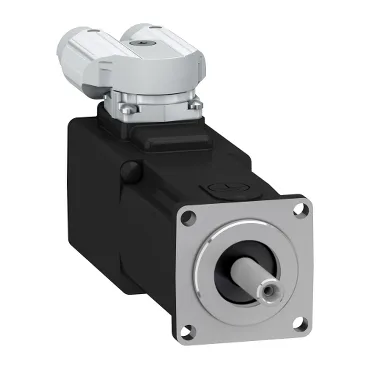
Speed and torque across the supply grid
The SH30401P06F2000: This SH3-series servo motor delivers 9000 rpm maximum mechanical speed when fed from a 400 V or 480 V three-phase drive — the same frame reaches 4000 rpm on 115 V or 230 V single-phase supply. The nominal torque holds at 0.184 N·m on three-phase versus 0.176 N·m on single-phase, so the motor's continuous power output climbs from 77 W on single-phase to 166 W on three-phase. That means the same order code covers both a low-voltage single-phase build and a full three-phase line — the drive tuning parameters handle the rest.
Holding brake and vertical-axis safety
The integrated holding brake delivers 0.4 N·m static torque — enough to hold a light vertical load on a Z-axis or gantry when the drive is disabled. The brake is spring-applied, power-released, so it engages on power loss without a separate safety relay. On a swap-out, the brake release mechanism (manual override, if fitted) lets you move the axis by hand for alignment before powering the drive.
Mechanical interface and environmental sealing
The 40 mm international standard flange (centring collar 30 mm diameter, 2.5 mm depth) with four 4.5 mm mounting holes matches the common NEMA 17 / 40 mm frame footprint — no adapter plate needed for most linear-actuator or rotary-stage mounts. The 8 mm smooth shaft extends 25 mm, so the coupling or pulley clamp zone is standard. IP54 at the shaft bushing without a seal ring; fit the optional shaft seal ring to reach IP65 on the motor body and bushing — that matters for washdown zones where coolant mist or fine dust is present. The rotatable right-angled connector lets the cable exit in any of four orientations, which simplifies routing in a tight cable trough.
Electrical parameters for drive tuning
Stator resistance is 17.2 Ω and inductance is 7.3 mH — a relatively high-impedance winding that limits the peak current to 4.5 A (both continuous maximum and 3 s peak). The torque constant is 0.19 N·m/A at 120 °C copper temperature, and the back-EMF constant is 13.6 V/krpm at 20 °C. These numbers feed directly into the drive's auto-tuning routine; if the drive asks for motor parameters, enter these values rather than relying on the default motor library entry, because the winding match determines the current-loop bandwidth and the torque linearity at low speed.