Speed and torque across supply voltages
The SH30401P06F2100: Nominal speed depends on the supply: 4000 rpm on 115 V or 230 V single-phase, and 9000 rpm on 400 V or 480 V three-phase. The maximum mechanical speed is 9000 rpm, so the three-phase versions run at the motor's top end. Nominal torque is 0.176 N.m on single-phase supplies and 0.184 N.m on three-phase. Continuous stall torque holds at 0.21 N.m across the 115-480 V three-phase range — useful for holding position at zero speed. Continuous power is 170 W, with nominal output power reaching 166 W on 400/480 V three-phase. The motor is naturally convection-cooled — no fan, so it relies on the mounting surface or ambient airflow for heat rejection.
Encoder, brake, and environmental sealing
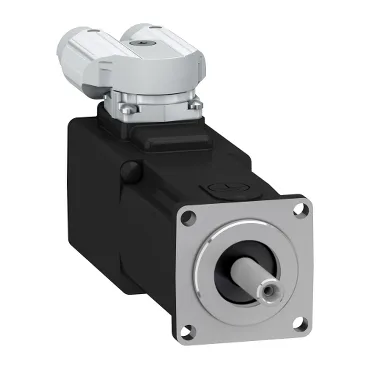
The absolute single-turn SinCos Hiperface encoder provides position feedback without a home cycle on power-up — the rotor position is known immediately. This matters for applications where the machine must resume from a known state after a power loss. The holding brake delivers 0.4 N.m of holding torque, enough to secure a vertical load or prevent shaft rotation when the drive is disabled. The brake is integrated — no external brake resistor or relay needed. The connector is a straight or rotatable right-angled type, giving flexibility in cable routing.
Mounting and mechanical interface
The motor uses an international standard flange with a 40 mm flange size and a 30 mm centring collar. The smooth shaft is 8 mm diameter, 25 mm long — no keyway, so the coupling must grip the shaft via a clamping or collet mechanism. Overall length is 99.4 mm (3.9 in), and the centring collar depth is 2.5 mm. Four mounting holes on a 4.5 mm diameter circle secure the flange to the mating face.