Supply-dependent speed and torque — the real performance envelope
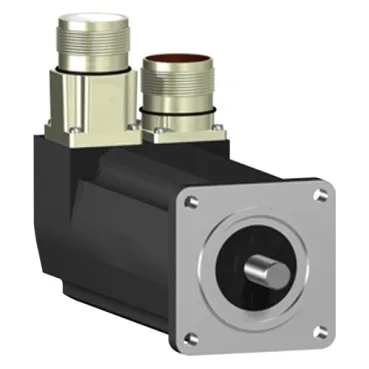
The SH30551P11F1100: This SH3 motor's nominal speed and torque shift with the supply you feed it — 2000 rpm at 115 V single-phase, 4000 rpm at 230 V single-phase, and 6000 rpm at either 400 V or 480 V three-phase. The nominal torque holds at 0.5 N.m on single-phase supplies but drops to 0.35 N.m on three-phase, while continuous power climbs from 100 W at 115 V single-phase to 440 W at 480 V three-phase. The continuous stall torque is 0.42 N.m across the 115-480 V three-phase range, with a continuous stall current of 0.73 A. Peak stall torque reaches 1.5 N.m — roughly 3.6× the continuous stall figure — giving you headroom for acceleration transients without oversizing the drive.
Absolute single-turn encoder — no homing, but one-revolution limit
The absolute single-turn SinCos Hiperface encoder means the motor knows its position within one revolution at power-up — no homing sequence needed on every cycle. The trade-off: single-turn tracks position within 360° only; multi-turn applications need a different encoder option or an external multi-turn battery backup on the drive side. The back EMF constant is 40 V/krpm at 20°C, and the torque constant is 0.58 N.m/A at 120°C copper temperature — these two numbers let you size the drive's DC bus voltage and current loop gain before you wire a cable.
Holding brake and IP65 — vertical-axis and washdown duty
The integrated holding brake delivers 0.8 N.m holding torque — enough to hold a light vertical axis at rest without servo current draw. The brake is a power-off engaged type (typical for servo motors), so the axis stays put on a power loss. The straight electrical connector is the wet-end interface; keep the mating cordset's O-ring seated to maintain the seal.
Low inertia, high resistance — fast acceleration with thermal limits
Maximum mechanical speed is 9000 rpm — the bearing and rotor balance limit, not the winding insulation. The maximum radial force Fr drops from 340 N at 1000 rpm to 170 N at 8000 rpm, so a direct-coupled load at high speed needs a lighter rotor or a compliant coupling.