Speed and torque across the supply range
The SH30552P02A2200: This motor delivers 6000 rpm on a 400 V or 480 V three-phase supply, but drops to 2000 rpm on 115 V single-phase and 4000 rpm on 230 V single-phase — the speed ceiling is supply-voltage dependent, not a fixed nameplate number. Nominal torque follows the same pattern: 0.63 N·m at 400/480 V three-phase, versus 0.77 N·m at 115 V single-phase and 0.75 N·m at 230 V single-phase. The motor is most torque-dense on the lower-voltage single-phase supply, but the speed penalty is steep. Continuous power is 530 W, with nominal output power rated at 600 W on 400 V three-phase and 670 W on 480 V three-phase — the extra 70 W on 480 V comes from the higher bus voltage before the drive limits current.
Encoder and feedback for closed-loop control
The absolute multiturn SinCos Hiperface encoder gives position feedback on power-up without a homing sequence — essential for applications where the axis position must be known immediately after a power cycle, like pick-and-place or gantry systems. The encoder type pairs with Schneider's Lexium drive family; the Hiperface protocol carries both position and temperature data on the same pair of wires, reducing cabling compared to incremental encoder setups.
Environmental sealing and mechanical fit
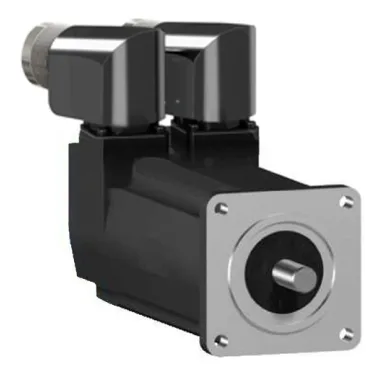
IP65 on the motor body and shaft bushing, plus IP67 on the housing — this motor handles washdown and dust ingress without a secondary cover, suitable for food processing or packaging lines where hose-down cleaning is routine. Smooth shaft, no holding brake, and a 55 mm flange with a 9 mm shaft diameter and 20 mm shaft length — it mounts to standard international flange patterns, but the smooth shaft means the load coupling relies entirely on the clamping force of the shaft collar, not a keyway. Natural convection cooling — no fan, so the motor relies on its own surface area and the machine frame for heat rejection. In a confined enclosure or high-ambient environment, the continuous torque may need derating below the 0.71 N·m stall figure.
Peak and continuous torque capability
Peak stall torque hits 2.5 N·m across the 115–480 V three-phase range, but only for short bursts — the continuous stall torque is 0.71 N·m at 1.2 A continuous stall current. The 4.8 A peak current (3-second rating) supports acceleration and deceleration cycles without tripping the drive.
Sourcing and lifecycle status
No stock-holding claim — each RFQ is handled on its own volume and lead-time terms.