Speed-torque envelope across supply voltages
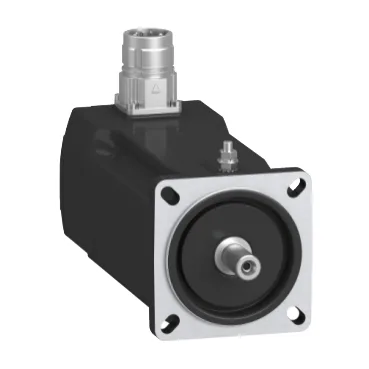
The SH30701P0AA3000: This SH3 frame servo delivers 690 W continuous output at 400 V three-phase and 480 V three-phase, dropping to 370 W on 230 V single-phase supply. Nominal speed is 3000 rpm at 230 V single-phase, 6000 rpm at 400 V three-phase, and 7200 rpm at 480 V three-phase — the speed ceiling follows the bus voltage, not the motor's 8000 rpm mechanical limit. Nominal torque holds at 1.1 N.m on both 400 V and 480 V three-phase supplies, but rises to 1.4 N.m on 230 V single-phase. The torque constant is 0.69 N.m/A at 120 °C copper temperature, so the drive's current loop must deliver at least 2.0 A continuous to reach that torque figure.
Feedback and mechanical fit
The absolute single-turn Hiperface DSL encoder provides position feedback over a digital serial link — no separate encoder cable required, but the drive must support the Hiperface DSL protocol. This is a single-turn device, so the absolute position resets on each power cycle; a multi-turn encoder would be needed for applications that must retain position through a power loss. Mounting uses an international standard flange with a 70 mm (2.8 in) flange size, 60 mm centring collar diameter, and 2.5 mm centring collar depth. The shaft is 11 mm diameter, 23 mm long, smooth (no keyway) — torque transmission relies on a clamping hub or shrink-fit coupling. Maximum radial force is 730 N at 1000 rpm, axial force 80 N.
Thermal and environmental limits
Cooling is by natural convection — no fan, so the continuous torque rating assumes free air circulation around the motor body. The copper winding temperature limit is 130 °C (266 °F); sustained operation above that accelerates insulation ageing and risks a winding short. The motor body carries IP65 protection, but the shaft bushing is only IP54 unless a shaft seal ring is fitted. In washdown environments (food, beverage, chemical processing), the seal ring is required to prevent moisture ingress along the shaft. The electrical connection uses a quick-lock straight connector — verify the mating connector's IP rating matches the installation.
Electrical parameters for servo tuning
Stator resistance is 10.4 Ω and inductance is 42.6 mH — a relatively high inductance that limits current slew rate. The drive's current regulator gains must be tuned for this L/R time constant of about 4.1 ms; default gains tuned for a lower-inductance motor will cause current-loop instability or overshoot.