Motor ratings and supply-voltage dependency
The SH30702P01F1000 is a three-phase servo motor from the SH3 series, delivering 1130 W continuous power. Its nominal speed depends on the supply: 1500 rpm at 115 V single-phase, 3000 rpm at 230 V single-phase, 6000 rpm at 400 V three-phase, and 7200 rpm at 480 V three-phase — the speed ceiling shifts with the available line voltage. Nominal torque also varies by supply: 2.15 N·m at 115 V single-phase, 2.1 N·m at 230 V single-phase, and 1.8 N·m at both 400 V and 480 V three-phase. Peak stall torque reaches 7.6 N·m across the 115-480 V three-phase range, giving headroom for acceleration transients.
Brake, encoder, and mechanical interface
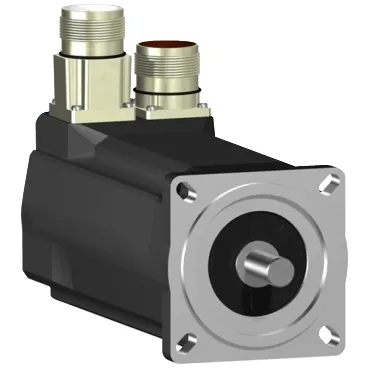
Feedback comes from an absolute single-turn SinCos Hiperface encoder, providing position at power-up without a homing cycle. The motor has a smooth shaft with 11 mm diameter and 23 mm shaft length, mounted on an international standard flange with 70 mm flange size and 60 mm centring collar.
Environmental protection and cooling
IP54 protection at the shaft bushing without the shaft seal ring, and IP65 for the motor body and shaft bushing when the seal ring is fitted — both conforming to IEC 60034-5. The IP65 rating suits washdown environments in food-and-beverage or packaging lines, provided the mating connector is also sealed. Cooling is by natural convection — no external fan or forced air required. This simplifies installation but means the continuous torque rating assumes free airflow around the motor body; derating applies if mounted in a confined space.
Electrical parameters for drive matching
Stator resistance is 4.2 Ω and stator inductance is 29.65 mH, giving the drive's current loop a relatively high inductance load. Maximum continuous current is 11.8 A RMS, with the same 11.8 A peak for 3-second overloads — the drive must be sized to supply this peak without tripping. The torque constant is 0.7 N·m/A at 120 °C copper temperature, and the back-EMF constant is 48 V/krpm at 20 °C. These values let the drive calculate the motor's electrical position and regulate torque accurately across the speed range.