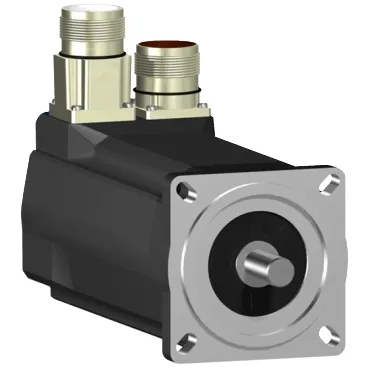
What this SH3 servo motor delivers on the line
The SH30702P02A1100 is a three-phase servo motor from Schneider Electric's SH3 family, rated for 1130 W continuous power with a continuous stall torque of 2.04 N.m across the 115...480 V three-phase range. Nominal speed and torque depend on the supply voltage: at 115 V single phase you get 1500 rpm and 2.15 N.m; at 400 V three phase it's 6000 rpm and 1.8 N.m; at 480 V three phase it reaches 7200 rpm at the same 1.8 N.m. The absolute multiturn SinCos Hiperface encoder gives you position feedback without needing a home cycle after power loss — the drive knows where the shaft is on startup.
Mounting and mechanical fit — what to check before bolting it in
Flange size is 70 mm (2.8 in) with an international standard flange pattern — it fits the common servo mounts in this power class. Centring collar diameter is 60 mm with a 2.5 mm depth; mounting holes are 5.5 mm diameter on the bolt circle. Smooth shaft, 11 mm diameter by 23 mm long — no keyway, so the coupling or pulley must transmit torque through a clamping or friction fit. No holding brake fitted, so for vertical-axis loads you'll need an external brake or a motor with the brake option. Maximum radial force at the shaft nose drops with speed: 710 N at 1000 rpm, down to 390 N at 6000 rpm. Maximum axial force is 80 N. Stay inside these limits to avoid bearing damage at high-speed runs.
Electrical and thermal — the numbers that set the drive tuning
Stator resistance is 4.2 Ohm and inductance is 10.65 mH — these set the electrical time constant and influence the current-loop tuning in the servo drive. Torque constant is 0.7 N.m/A at 120 °C copper temperature; back EMF constant is 48 V/krpm at 20 °C. Continuous stall current is 2.9 A; peak current (3 s) is 11.8 A. The drive needs to supply that peak for acceleration and deceleration without tripping on overcurrent. Cooling is natural convection — no fan, so the motor relies on the mounting surface and ambient airflow for heat rejection. IP65 rating on both the motor body and the shaft bushing means it handles washdown environments as long as the connector is properly mated.
Cabling and connectors — two options for the panel layout
The motor accepts either a rotatable right-angled connector or a straight connector — choose based on cable exit direction in your cabinet. The connector is part of the motor assembly, not a separate order item.