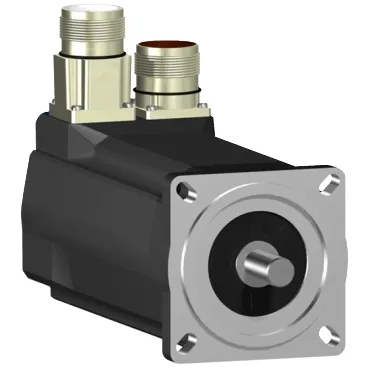
Motor sizing and speed-torque envelope
The SH30703M02A1100 is a 3-pole servo motor from the SH3 series, delivering 830 W continuous power with nominal torque ranging from 2.63 N.m at 400/480 V three-phase up to 3.05 N.m at 115 V single-phase — the torque you get depends on the supply you feed it. Nominal speed shifts with voltage: 3000 rpm on 400 V three-phase, 3600 rpm on 480 V three-phase, and drops to 750 rpm on 115 V single-phase or 1500 rpm on 230 V single-phase. That means the same motor body covers a wide speed range, but the drive must be configured for the actual line voltage. Peak stall torque hits 11.3 N.m across the 115-480 V three-phase range, while continuous stall torque is 2.94 N.m at 2.1 A continuous stall current. The 8.7 A maximum Irms and 8.7 A 3-second peak current tell you the drive needs to supply that peak for acceleration without tripping.
Encoder feedback and mechanical fit
The absolute multiturn SinCos Hiperface encoder gives you position hold on power loss — no homing routine on restart. This makes the motor a natural fit for gantry or rotary indexing axes where the controller expects to know the position immediately after a power cycle. IP65 rating on both the motor body and the shaft bushing per IEC 60034-5 means it handles washdown and dust — fine for food processing or wet machining environments, but the connector must be mated with the matching IP65-rated cable to maintain the seal.
Cooling, wiring, and load limits
Natural convection cooling means no fan — the motor relies on surface area and the machine's own airflow. In a confined cabinet or still-air mount, derate the continuous torque below the 2.94 N.m stall figure if the ambient exceeds 40 °C; the 130 °C copper hot temperature is the winding limit, not the operating surface. Electrical connection options are a rotatable right-angled connector or a straight connector — both are field-swappable, letting you route the cable out the back or the side depending on the machine layout. The torque constant is 1.4 N.m/A at 120 °C, and the back EMF constant is 95 V/krpm at 20 °C, which the drive uses to calculate the velocity loop gain. Maximum radial force drops with speed: 730 N at 1000 rpm down to 400 N at 6000 rpm. Axial force limit is 80 N. If your application overhangs a belt or gear, check the radial load at the operating speed against these values — exceeding them pushes the bearing out of its life curve.