Motor sizing and speed-torque across supply voltages
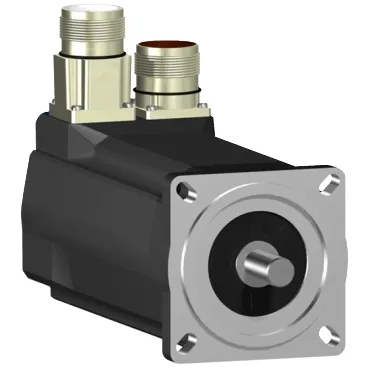
The SH30703M02A1200: This SH3-frame servo delivers 830 W continuous power, with nominal speed and torque shifting with the supply: at 400 V three-phase it spins 3000 rpm with 2.63 N·m nominal torque; at 480 V three-phase it reaches 3600 rpm at the same 2.63 N·m. Single-phase 115 V yields 750 rpm / 3.05 N·m, and 230 V single-phase gives 1500 rpm / 2.95 N·m — so the same motor covers both line voltages and phase configurations, but the integrator sizes the drive and cables for the actual supply. Peak stall torque hits 11.3 N·m across the 115–480 V three-phase range, while continuous stall torque is 2.94 N·m at 2.1 A continuous stall current. The 8.7 A maximum current (3 s peak) defines the drive's peak current requirement — match the servo drive to at least this peak for full torque delivery during acceleration.
Encoder feedback and mechanical interface
The absolute multiturn SinCos Hiperface encoder provides position feedback without a home cycle on power-up — critical for applications that must resume position after a power loss. The rotatable right-angle connector and straight connector options give flexibility in cable routing within tight cabinets. Smooth shaft (no keyway) on a 14 mm diameter, 30 mm shaft length with a 5 mm key width. The international standard flange is 70 mm with a 60 mm centring collar and 2.5 mm centring collar depth. Mounting holes are 5.5 mm diameter — standard M5 or equivalent hardware.
Environmental sealing and thermal limits
Cooling is natural convection only; no external fan or liquid cooling — derate if mounted in a confined space with restricted airflow. Copper hot temperature limit is 130 °C. The torque constant is 1.4 N·m/A at 120 °C, and back EMF constant is 95 V/krpm at 20 °C — these thermal coefficients matter when the motor runs near its thermal ceiling; expect torque constant to drop and back EMF to rise as winding temperature increases.
Bearing load capacity and radial force derating
Maximum radial force Fr is 730 N at 1000 rpm, derating to 400 N at 6000 rpm — the bearing life is directly affected by belt tension or direct-drive overhung loads. Maximum axial force Fa is 80 N. For belt-driven applications, calculate the resultant radial load at the operating speed and stay below the curve to avoid premature bearing failure.