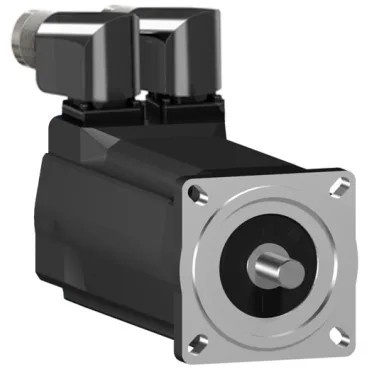
Motor sizing and torque delivery
The SH30703P02F2200 is a three-phase servo motor from the SH3 family, with a 70 mm flange and a smooth shaft (14 mm diameter, 30 mm shaft length). It delivers 1330 W continuous power, with a continuous stall torque of 2.94 N·m across the 115–480 V three-phase range, and a peak stall torque of 11.3 N·m for short-duration acceleration.
Speed range and voltage dependency
Nominal speed varies with supply voltage: 1500 rpm at 115 V single phase, 3000 rpm at 230 V single phase, 6000 rpm at 400 V three phase, and 7200 rpm at 480 V three phase. The nominal torque also shifts — 2.95 N·m at 115 V single phase, dropping to 2.1 N·m at 400 V three phase — so the torque-speed envelope must be matched to the drive's DC bus voltage. The nominal output power follows the same pattern: 460 W at 115 V single phase, 880 W at 230 V single phase, 1450 W at 400 V three phase, and 1550 W at 480 V three phase. For a 480 V line, the motor delivers the highest power and speed; for a 230 V single-phase supply, expect roughly half the power.
Encoder and feedback for position loops
The encoder is an absolute multiturn SinCos Hiperface type — this gives single-turn position within one revolution and multiturn counts over multiple revolutions, so the controller knows the absolute position at power-up without a homing move. The SinCos analog track provides high-resolution velocity feedback for the servo drive's current and speed loops. The torque constant is 0.72 N·m/A at 120 °C copper temperature, and the back EMF constant is 49 V/krpm at 20 °C. These values let the drive calculate the motor's electrical model for field-oriented control; the stator resistance is 2.7 Ω and inductance is 20.3 mH.
Environmental sealing and mechanical limits
The motor body is rated IP65 per IEC 60034-5, the shaft bushing is IP65, and the housing is IP67 — so the motor withstands washdown and dust ingress when the connector is mated. Cooling is by natural convection, so no external fan is required; derate if mounted in a confined space with restricted airflow. Maximum radial force on the shaft is 730 N at 1000 rpm, decreasing to 400 N at 6000 rpm. Maximum axial force is 80 N. These limits govern the coupling selection — a belt drive or direct load must not exceed these forces at the operating speed.
Sourced against an RFQ through authorized distribution. The mounting support is an international standard flange (70 mm centring collar, 60 mm diameter, 2.5 mm depth) — fits standard servo-mount patterns.