Motor ratings that set the drive package
The SH30703P1AF4000 delivers 1.33 kW continuous power at 400 V three-phase, with a nominal torque of 2.1 N.m at that voltage — the torque drops from the 2.8 N.m available on 230 V single-phase supply, so the drive sizing must account for the actual line voltage at the install site. Nominal speed hits 3000 rpm on 230 V single-phase, 6000 rpm on 400 V three-phase, and 7200 rpm on 480 V three-phase — the motor's speed range is supply-voltage dependent, not a single fixed rating. Peak stall torque reaches 11.3 N.m across the 115...480 V three-phase range, and continuous stall torque is 2.94 N.m — the peak figure governs acceleration and emergency stop profiles, while the continuous stall sets the holding limit for dwell periods.
Brake and encoder — what they mean for the axis
The holding brake delivers 3 N.m static holding torque — sufficient to hold a vertical load at standstill without the drive maintaining current, but it is a holding brake, not a dynamic braking resistor; the drive's deceleration ramp must keep the DC bus below the overvoltage threshold during fast stops. Brake pull-in power is 7 W — a small load on the 24 VDC control supply, but the brake release time and the drive's enable sequence must be coordinated to prevent the axis from dropping before the motor develops torque. The absolute single-turn Hiperface DSL encoder eliminates the need for a homing sequence on power-up — the position is known immediately, which cuts cycle time on machines that power-cycle between batches.
Mechanical interface and mounting constraints
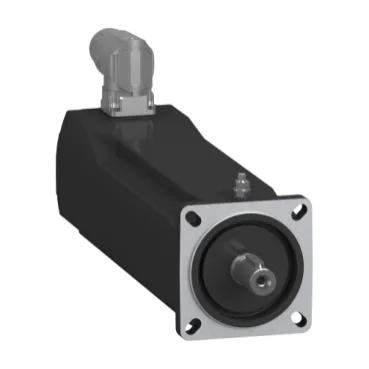
Flange size is 70 mm (IEC standard), shaft diameter 14 mm with a parallel key and 30 mm shaft length — the mounting footprint matches the SH3 frame, so a swap into an existing SH3 installation requires no bracket rework. Overall length is 246 mm (9.7 in) — this is the body length excluding the connector protrusion; the straight connector and the optional quicklock rotatable right-angled connector add different overhang, so cable routing clearance must be checked against the panel depth. IP65 on the motor body per IEC 60034-5, but the shaft bushing without the shaft seal ring drops to IP54 — if the application sees directed washdown, the optional shaft seal ring must be specified to maintain IP65 at the shaft exit. Maximum radial force is 1050 N at 1000 rpm, and maximum axial force is 160 N — these set the belt-tension and coupling-load limits; exceeding them shortens bearing life and can cause the encoder to lose position tracking.
Electrical parameters for drive tuning
Stator resistance is 2.7 Ohm and stator inductance is 7.3 mH — these feed the auto-tuning routine in the drive; the motor's electrical time constant (L/R) is about 2.7 ms, which sets the current-loop bandwidth ceiling. Torque constant is 0.72 N.m/A at 120 °C copper temperature, and the back EMF constant is 49 V/krpm at 20 °C — the back EMF rises with motor speed and must stay below the drive's DC bus voltage to maintain current regulation at high speed. Maximum current Irms is 17.0 A, and the 3-second peak output current is also 17.0 A — the motor's thermal limit is the continuous current at rated torque, not the peak; the drive's current limit should be set to the motor's continuous rating for sustained operation.
No minimum order quantity is stated — single-unit and production volumes are both quotable. The sizing reference SH30703P ties this motor to the SH3 frame family — if the project needs a different torque or speed point, the SH3 series offers variants within the same flange and shaft dimensions, but no direct pin-compatible alternative is listed for this exact order code.