Nominal speed and torque across supply voltages
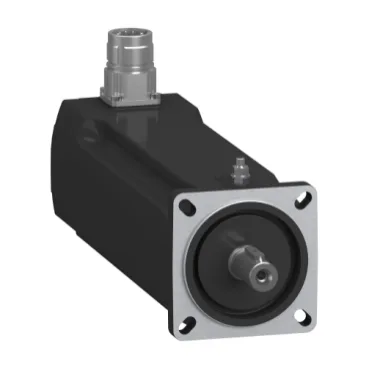
The SH30703P1BA3000: This SH3 frame motor delivers 3000 rpm nominal on 230 V single-phase supply, but jumps to 6000 rpm on 400 V three-phase and 7200 rpm on 480 V three-phase — so the speed you get depends entirely on the line voltage you feed it. Nominal torque follows the same pattern: 2.8 N·m at 230 V single-phase, dropping to 2.1 N·m at both 400 V and 480 V three-phase. That means if you're running it on a three-phase line, you lose about 25 % of the low-voltage torque — plan your load accordingly. Continuous power is 1330 W on three-phase supplies (400 V or 480 V), but only 830 W on 230 V single-phase. The motor is naturally convection-cooled, so no fan to fail, but the thermal budget is set by the winding temperature limit of 130 °C.
Encoder and feedback — absolute multitouch Hiperface DSL
The built-in absolute multiturn Hiperface DSL encoder gives you position feedback without needing a battery backup or a home cycle on power-up. That's a real time-saver during commissioning — you power the drive, it knows where the axis is. The torque constant is 0.72 N·m/A at 120 °C copper temperature, and the back EMF constant is 49 V/krpm at 20 °C. These numbers let you size the drive's current loop and predict the bus voltage needed to reach top speed without saturating the drive.
Stall torque and current — what the motor can hold
Continuous stall torque is 2.94 N·m across the 115–480 V three-phase range, with a continuous stall current of 4.1 A. That's the torque the motor can hold indefinitely without overheating — useful for clamping or holding applications.
Mounting and environmental sealing
The motor uses an international standard flange with a 70 mm flange size and a 60 mm centring collar. The shaft is 14 mm diameter with a parallel key, and the overall length is 220 mm — fits the standard SH3 frame envelope. IP65 on the motor body per IEC 60034-5 means it handles washdown and dust — but the shaft bushing without a shaft seal ring is only IP54, so if you're in a wet environment, you'll want the optional shaft seal to keep water out of the bearing area. The electrical connection uses a rotatable right-angled connector and a quicklock straight connector — both are field-rotatable, which helps when the cable exit direction needs to change without a custom cable.