Speed and torque across supply voltages
The SH31001M02A1200 delivers 3000 rpm nominal speed on a 480 V three-phase supply, dropping to 2500 rpm at 400 V three-phase, 1250 rpm at 230 V single-phase, and 625 rpm at 115 V single-phase — the speed follows the line voltage linearly, so a machine designed for 480 V will run at half speed on a 230 V line without a drive parameter change. Nominal torque holds at 22.30 lbf·in (2.52 N·m) across both 400 V and 480 V three-phase supplies, rising slightly to 23.99 lbf·in (2.71 N·m) at 230 V single-phase and 24.8 lbf·in (2.8 N·m) at 115 V single-phase — the torque curve is flat enough that the motor maintains useful output even on a single-phase line, though the continuous power drops from 930 W at 480 V to 210 W at 115 V.
Encoder feedback and environmental sealing
The absolute multiturn SinCos Hiperface encoder provides position feedback without a home cycle on power-up — the multiturn count tracks absolute position over multiple shaft revolutions, so the controller knows the axis location immediately after a power loss or E-stop. IP65 on the motor body and shaft bushing, plus IP67 on the housing per IEC 60034-5, means the motor withstands washdown spray and temporary immersion — suitable for food-and-beverage or washdown-duty axes where the motor is exposed to hose-down cleaning. The rotatable right-angled connector and straight connector options let the cable exit adapt to tight cabinet layouts — the connector orientation is field-adjustable without opening the motor housing.
Mechanical interface and load limits
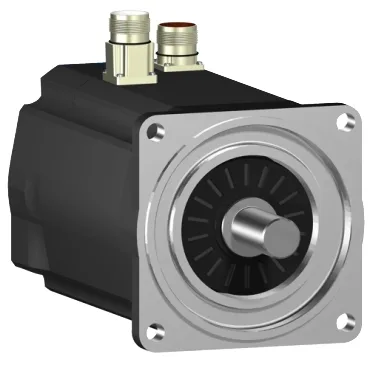
The 100 mm flange (IEC standard) with a 19 mm smooth shaft and 40 mm shaft length mounts directly to standard gearbox input flanges — the 6 mm keyway and 3.5 mm centring collar depth locate the coupling repeatably. Maximum radial force is 900 N at 1000 rpm, dropping to 530 N at 5000 rpm — the bearing load limit follows the speed inversely, so a belt-drive or overhung load must be sized for the operating speed, not the static rating. Maximum axial force is 160 N — thrust loads from helical gears or lead-screw preload must stay under this limit to avoid bearing damage.