Motor sizing and speed-torque across supply voltages
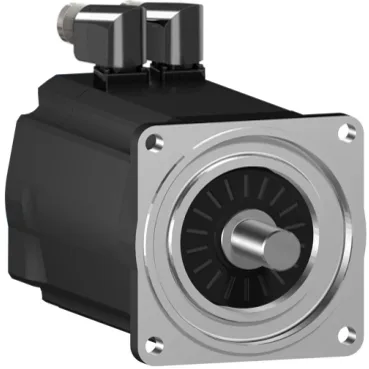
The SH31001M02A2000: This SH3 frame motor delivers 660 W continuous power, but the nominal speed and torque depend on what supply you feed it. At 480 V three-phase it spins 3000 rpm with 22.30 lbf·in (2.52 N·m) nominal torque; drop to 400 V three-phase and the speed is 2500 rpm at the same torque. On single-phase 230 V you get 1250 rpm at 23.99 lbf·in (2.71 N·m), and on 115 V single-phase it's 625 rpm at 24.8 lbf·in (2.8 N·m). The peak stall torque is 85.0 lbf·in (9.6 N·m) across the 115–480 V three-phase range, and continuous stall torque sits at 26.02 lbf·in (2.94 N·m) on the same three-phase supply.
Encoder feedback and cable connection
The feedback device is an absolute multiturn SinCos Hiperface encoder — that gives you position data on power-up without a homing move, which is a real time-saver on multi-axis lines. The electrical connection uses a rotatable right-angled connector, so you can route the cable bundle in tight cabinets without stressing the gland. This variant ships without a holding brake, so if your vertical axis needs to hold position at power-off, you'll need to add an external brake or spec the braked version. The shaft is smooth (no keyway), 19 mm diameter by 40 mm long, with a 6 mm key width — confirm your coupling or pulley fits that interface.
Mounting flange and environmental protection
The motor flange is 100 mm (3.9 in) with an international standard pattern, a 95 mm centring collar, and 9.0 mm mounting holes — it bolts directly to common gearbox and actuator flanges. Overall length is 168.5 mm (6.6 in). Protection rating is IP54 at the shaft bushing without the shaft seal ring, or IP65 on the motor body and with the shaft bushing seal fitted, per IEC 60034-5. If the motor sees washdown or coolant spray, make sure the shaft seal ring is installed. Cooling is natural convection — no fan, so keep ambient airflow in mind if the duty cycle is high. Maximum radial force at the shaft nose is 900 N at 1000 rpm, dropping to 530 N at 5000 rpm — this sets the belt-tension or overhung-load limit. Maximum axial force is 160 N.