Supply-dependent speed and torque — the spec line that matters
The SH31001M02A2200 is a three-phase servo motor, but its nominal speed and torque shift with the supply voltage — 625 rpm / 2.8 Nm at 115 V single-phase, 1250 rpm / 2.71 Nm at 230 V single-phase, 2500 rpm / 2.52 Nm at 400 V three-phase, and 3000 rpm / 2.52 Nm at 480 V three-phase. The nominal output power also varies: 210 W at 115 V single-phase, 410 W at 230 V single-phase, 790 W at 400 V three-phase, and 930 W at 480 V three-phase. Continuous power is 660 W — this is the thermal limit under natural convection cooling, so the motor's usable duty cycle depends on the actual load profile and ambient temperature.
Encoder and feedback — Hiperface absolute multiturn
The encoder is an absolute multiturn SinCos Hiperface type — this is a common open-standard feedback interface used by Schneider's Lexium drives and many third-party servo drives. Multiturn absolute means the encoder tracks position over multiple shaft revolutions even after power loss; the SinCos analog tracks provide fine interpolation for high-resolution positioning. The back EMF constant is 115 V/krpm at 68 °F (20 °C) — this sets the voltage-speed relationship and must match the drive's DC bus voltage headroom.
No holding brake — plan for external braking
This variant ships without a holding brake — the motor relies on the drive's holding torque or an external brake for vertical-axis or safety-hold applications. Continuous stall torque is 2.94 Nm across the 115–480 V three-phase range, with a peak stall torque of 9.6 Nm — the peak figure is available for acceleration but not for holding at standstill without a brake.
IP rating and environmental sealing
The motor body and shaft bushing are rated IP65, while the housing is rated IP67 — the housing seal is one class higher, meaning the connector area is better protected against immersion than the motor body itself. Cooling is by natural convection — no fan or forced air, so the motor relies on the mounting flange and ambient airflow for heat dissipation.
Mechanical interface and mounting
The motor uses an international standard flange with a 100 mm flange size, 95 mm centring collar diameter, and 3.5 mm centring collar depth — this is a standard IEC mounting pattern for servo motors in this power class. The shaft is 19 mm diameter, 40 mm long, smooth (no keyway), with a 6 mm key width — the smooth shaft means the coupling or pulley must use a clamping or friction-fit method. Maximum radial force is 900 N at 1000 rpm, derating to 530 N at 5000 rpm — this is the limiting factor for belt-drive or overhung-load applications; maximum axial force is 160 N.
Electrical parameters and winding data
Stator resistance is 13.9 Ohm and stator inductance is 99.15 mH — these are the winding parameters the drive's autotuning routine uses to set current loops and velocity gains. Maximum continuous current (Irms) is 6.3 A, with a continuous stall current of 1.8 A — the ratio between these tells you the motor's overload capability for short-duration peak moves. The torque constant is 1.63 Nm/A at 248 °F (120 °C) — this is the hot winding value, so expect slightly higher torque per amp when the motor is cold. The motor has 4 poles and a maximum mechanical speed of 6000 rpm — the electrical frequency at 6000 rpm is 200 Hz, which the drive's output stage must support.
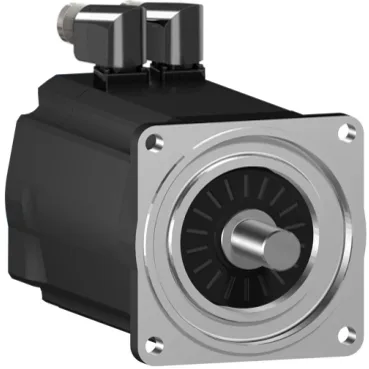
The electrical connection uses a straight connector and a rotatable right-angled connector — the right-angled option allows cable exit in tight panel layouts.